
One of these was found inside the mitochondrial genome, where nobody expected peptides to be encoded at all. The other was assembled deliberately from a fragment of a pituitary hormone plus a protective tail. MOTS-c and Semax could hardly have arrived by more different routes, and it shows in everything from their literatures to how carefully you have to handle them.
Proxiva Analytical DeskCertificate review, purity and identity testing
Key takeaways
- You are looking at two compounds from completely different worlds, and only one of them is checkable by you directly.
- Semax will frustrate you. Most of its primary work sits in a language you probably cannot read, and the English summaries mostly cite each other.
- MOTS-c you can read. What you cannot do is trust it yet — the field is barely a decade old and nothing has been properly challenged.
- So you have one compound you cannot verify and one nobody has verified. Those feel similar and they are not.
- Neither has been studied against the other, so anyone ranking them for you has made the ranking up.
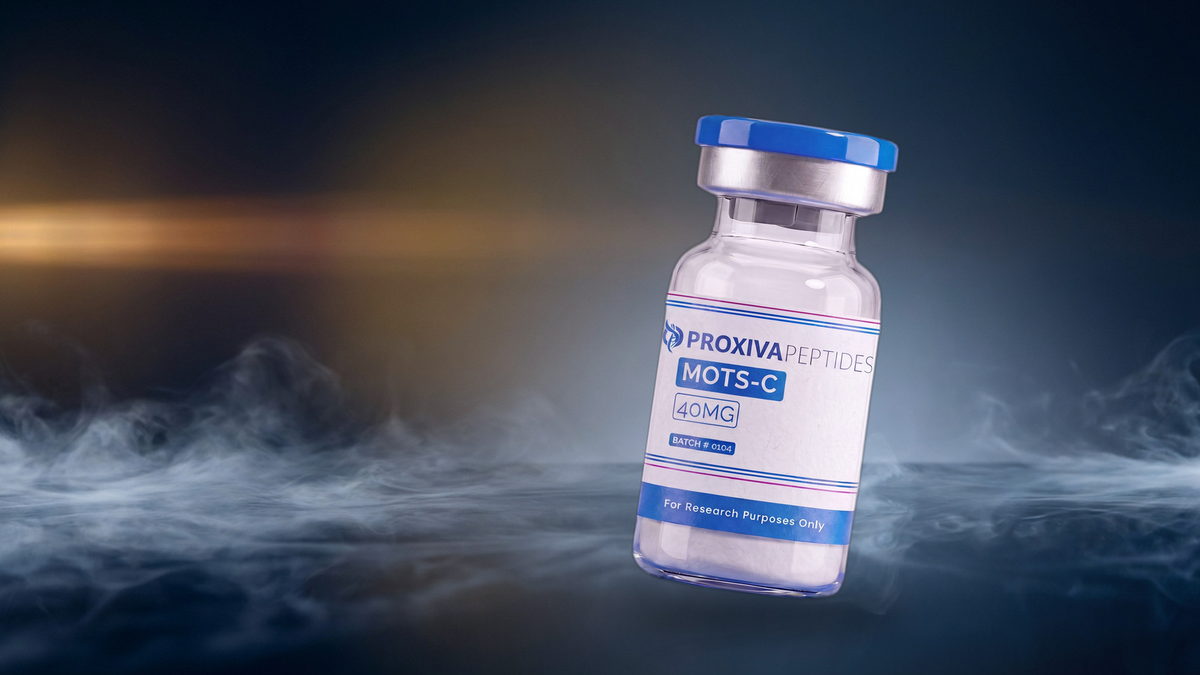
Where each one came from
MOTS-c: a genome nobody was reading
Mitochondria carry their own small genome — a legacy of their evolutionary origin as independent organisms. In humans it encodes a modest number of genes, most of them components of the respiratory chain. Nobody was looking there for signalling peptides.
MOTS-c is a 16-residue sequence found within that genome that appears to be translated and to have activity beyond the respiratory machinery. It belongs to a small, recently described category — mitochondrial-derived peptides — and the reframing is a large part of why it is studied at all.
Semax: assembled on purpose
Semax is a heptapeptide, and every part of it was chosen. Take residues 4 through 10 of adrenocorticotropic hormone — methionine, glutamate, histidine, phenylalanine — because that region retains nervous-system activity without the sequence needed for the parent's endocrine effect. Then append proline-glycine-proline, because native fragments are cleaved within minutes and proline's ring structure resists the peptidases that would do it.
One is a natural product found in a surprising place. The other is a deliberate construction solving a known problem.
So which should you actually be looking at?
Neither is a better compound. They answer different questions, and the honest way to choose is to work out which question you are asking.
Working on mitochondrial function or cellular energy handling? That is MOTS-c. It is the one with the unusual genomic origin and the metabolic research context.
Working on neurotrophic or cognitive questions? That is Semax. Different literature, different mechanism, no overlap with the first.
Want both? They do not interfere, and plenty of panels carry both. There is no reason to choose.
What you should not do is pick based on which sounds more impressive. MOTS-c has a genuinely striking origin story — a peptide encoded inside the mitochondrion, in a genome nobody was reading for signals. That is interesting. It is not evidence about what the compound does, and a lot of writing about MOTS-c leans on the discovery to imply things the research has not shown.
Semax has the opposite problem. Decades of work sounds reassuring until you try to trace a specific claim and find twelve English articles citing each other. Age of literature is not the same as weight of evidence.
Both are worth studying. Neither deserves the confidence they are usually described with.
Side by side
| MOTS-c | Semax | |
|---|---|---|
| Length | 16 residues | 7 residues |
| Origin | Mitochondrial genome | Synthetic, from an ACTH fragment |
| Natural or built | Natural sequence | Engineered — fragment + protective tail |
| Research context | Mitochondrial signalling, metabolic | Neurotrophic, cognitive |
| Specific liability | None distinctive | Methionine at position 1 — oxidises |
| Literature age | Recent, thin | Older, largely Russian-language |
| Also sold as | a pre-filled pen | blended with Selank |
The row that matters most in practice is the liability line, and it is the subject of the next section.

Semax has one predictable weakness
Position one of the Semax sequence is methionine, the most oxidation-prone of the common amino acids.
Its side chain ends in a thioether — sulfur bonded to two carbons — and thioethers oxidise readily to the sulfoxide on contact with atmospheric oxygen. Once oxidised, the residue's size, polarity and hydrogen-bonding all change, and the molecule is no longer quite the one on the label.
Two things follow, and both are actionable rather than theoretical:
- Minimise draws. Every puncture of the stopper admits air. For a peptide without methionine this is a minor consideration; here it is the main one.
- Read the chromatogram, not the percentage. Methionine sulfoxide elutes at a different retention time from the parent peptide, so a notable secondary peak may be exactly this. The purity figure averages it away; the trace shows it.
MOTS-c has no comparable single point of failure. At sixteen residues it follows ordinary peptide discipline — cold, dark, dry, reconstituted carefully — with no compound-specific vulnerability to plan around.
Two literatures with opposite problems
Here is where you need to be careful, and the care needed is different for each.
Take Semax first. Can you actually read the evidence? Probably not directly. Much of the primary work sits in Russian-language journals, produced under research conventions that differ from the ones you are used to.
Does that make it bad work? No, and you should resist that conclusion. It makes it hard for you to check, which is a different problem and in some ways a worse one.
So what happens? English summaries cite other English summaries. You read something confident, and it turns out to be a summary of a summary. How far back does your claim actually go? Usually you cannot tell without real effort.
Now MOTS-c. Can you read the evidence? Yes — it is accessible, recent, and written under conventions you recognise. So what is the catch?
Time. The class was described only in the last decade. Most of what exists is preclinical. Nothing has had the chance to be challenged, replicated, or quietly overturned, which is what normally separates a finding from a fact.
So how should you read each one? For Semax, ask whether the claim reaches a primary source at all, and count the steps. For MOTS-c, you will usually find the source easily — ask instead whether anyone has reproduced it, and in what model.
What do they share? Both leave room for confident assertion. One because you cannot check it, the other because nobody has checked it yet. Notice that gap, because it is exactly where overconfident writing collects.
Verification
Standard requirements for both, with different emphasis.
For MOTS-c, sixteen residues sits in a range where mass spectrometry is decisive rather than merely suggestive — specific enough to identify the compound, small enough to measure precisely. A supplier declining to provide it for a peptide of this length has no technical excuse.
For Semax, the mass result carries extra weight because it shares its Pro-Gly-Pro tail with Selank and similar constructs. Structural similarity means a clean HPLC trace is weak identity evidence between them — the molecular weights differ, and only the mass separates them.
- HPLC purity with the chromatogram image, not a bare figure
- Mass-spectrometry identity against the theoretical mass for that exact sequence
- Batch number matching the vial label
- Named testing laboratory, independent of the synthesis facility
- Residual solvent panel — TFA, acetonitrile, DMF
- Water and counterion content, which set net peptide per stated milligram
Field detail in how to read a certificate of analysis.
Handling: one needs air discipline
The procedures are the same. The margin is not.
MOTS-c is sixteen residues with no residue carrying a notable liability. Ordinary care genuinely suffices — cold, dark, reconstituted carefully, refrigerated after.
Semax has methionine at position one, and methionine oxidises on contact with air. So the one habit worth building specifically for it is fewer draws. Every puncture of the stopper admits atmosphere; for a peptide without methionine that is a minor consideration, and here it is the main one.
There is a compensation. Oxidised Semax elutes away from the parent peak, so the damage is partly visible on a chromatogram in a way most peptide degradation never is. That makes the trace worth more than the percentage for this compound specifically.
MOTS-c is also sold as a pre-filled pen, which removes reconstitution entirely at the cost of a fixed concentration. Standard technique for both is in reconstituting research peptides.
Frequently asked questions
Which one should you pick?
That depends entirely on which field your question sits in. MOTS-c belongs to mitochondrial metabolism. Semax belongs to neurological research. Your question already belongs to one of them.
Can you trust what you read about Semax?
Be careful here. Trace any claim backwards and count how many steps you take before reaching something anyone actually measured. You will often run out of steps.
Is MOTS-c better evidenced?
You can at least read its evidence, which is not the same as it being settled. The class is roughly a decade old and most of what exists is preclinical.
Are they related at all?
No. You are seeing them together because both get filed under performance and metabolism, which is a shelf label rather than a shared mechanism.
Which is harder for a supplier to make?
MOTS-c, at sixteen residues against Semax's seven. Ask for the chromatogram and look beside the main peak — that is where the failures of a long synthesis hide.
Can you run them together?
Nothing published tells you what happens. And if you run both at once, whatever you observe will have two possible causes and no way for you to separate them.
Related research compounds
- Bacteriostatic Water — $12.00
- Klow Full Kit (10 Vials) — 20% Off — $760
- CJC-1295 No DAC — $62
- TB-500 Full Kit (10 Vials) — 20% Off — $300
- HGH 191aa Full Kit (10 Vials) — 20% Off — $240
- Glow Full Kit (10 Vials) — 20% Off — $696
- NAD+ — $50
- SS31 – 10mg — $80
- MOTS-C Full Kit (10 Vials) — 20% Off — $280
- L - Carnitine — $55
- Wolverine Blend Pen 30mg+20mg/3ml — $350
- NAD+ Full Kit (10 Vials) — 20% Off — $200
- Selank + Semax Full Kit (10 Vials) — 20% Off — $720
- KPV Full Kit (10 Vials) — 20% Off — $200
- MT-1 – 10mg — $50
Further reading
- AOD 9604 vs MOTS-C: A Research Comparison
- Dihexa Reconstitution: Solubility, Diluent Choice and Handling
- GLP2 T vs MOTS-C: A Research Comparison
- Glutathione vs MOTS-C: A Research Comparison
- Ipamorelin vs MOTS-C: A Research Comparison
- GLP1 S vs Semax: A Research Comparison
- Semax vs Selank: Comparing Two Research Peptides
Research use only. All products referenced on this page are sold strictly for laboratory and research purposes. They are not drugs, foods, cosmetics, or medical devices, and they are not intended to diagnose, treat, cure, or prevent any disease. They are not for human or veterinary consumption. Handling should be performed only by qualified individuals in an appropriate laboratory setting.