
Ipamorelin and MOTS-c are searched against each other because both appear under the heading of metabolic and performance research. Structurally they have almost nothing in common, and the one difference that matters is not the one usually cited.
Proxiva Compliance DeskResearch-use standards and labelling
Key takeaways
- Ipamorelin works through an endocrine axis. It binds a receptor in the pituitary and the effect is produced by a hormone released downstream, not by the peptide itself.
- MOTS-c has no comparable axis. It is encoded in mitochondrial DNA and acts on intracellular metabolic signalling without a defined surface receptor of the same kind.
- That difference governs experimental design more than any potency comparison does: an axis has feedback, and feedback means the response to a fixed input changes over time.
- Verification requirements diverge accordingly. Ipamorelin is a five-residue sequence with straightforward mass confirmation; MOTS-c is sixteen residues and the harder synthesis.
- Neither substitutes for the other in any experimental sense. They are searched together because of shared vocabulary, not shared biology.
Establish which question you are asking
Before comparing these two on any axis, settle one thing: whether the work concerns a hormonal axis or concerns cellular metabolism directly. The two peptides sit on opposite sides of that line and the line is not crossable.
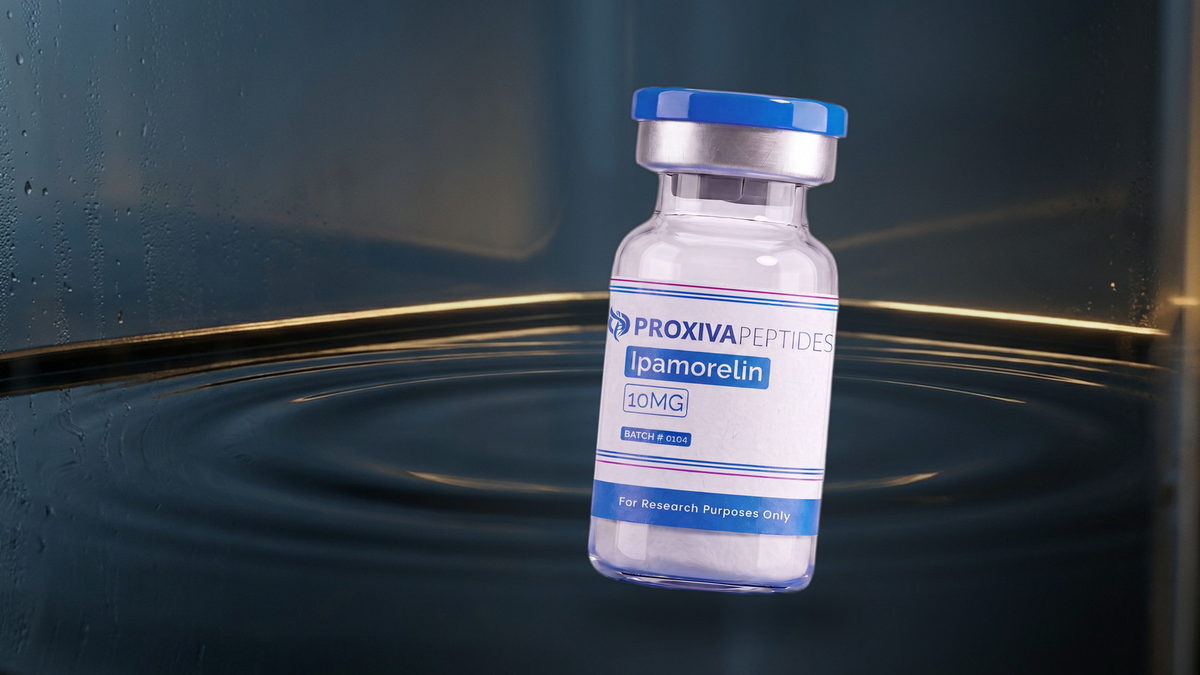
Ipamorelin is a growth hormone secretagogue. It binds the ghrelin receptor in the anterior pituitary and prompts release of growth hormone already synthesised and stored there. The peptide is a trigger. Whatever is observed downstream is the work of the hormone it released, not of the peptide, and the peptide's own presence in circulation is brief.
MOTS-c is a mitochondrial-derived peptide, encoded within mitochondrial DNA rather than the nuclear genome. It participates in metabolic signalling inside the cell. There is no equivalent gland, no stored reserve being released, and no single hormone carrying the effect onward.
This is why potency comparisons between them are meaningless. One is measured by how much hormone it causes to be released; the other has no comparable output to measure. There is no shared unit.
Why the axis matters more than the mechanism description
Mechanism descriptions are where most comparisons stop. The more consequential point is what having an axis does to an experiment over time.
An endocrine axis is a regulated system. Pituitary stores are finite and replenished on their own schedule, and the axis carries feedback from downstream products back to its own control points. The practical consequence is that a fixed input does not produce a fixed output indefinitely. Response to repeated identical stimulation of an axis changes, and it generally attenuates.
Anything acting through that axis inherits the property. A design that assumes a stable response to a stable input has assumed away one of the axis's defining behaviours, and any result read from such a design will be difficult to interpret.
MOTS-c carries no equivalent constraint from this source. That is not an advantage — it simply means the confound is absent and a different set applies. But it does mean that a comparison written as though the two are interchangeable metabolic inputs has missed the structural difference that most affects what either can be used to find out.
Related secretagogues sit on the same side of the line. CJC-1295 without DAC and the combined CJC-1295 and Ipamorelin preparation act on the same axis by a complementary route, and inherit the same feedback behaviour. Tesamorelin does likewise.
How the two ended up in the same conversation
It is worth understanding why this comparison is searched at all, because the reason is linguistic rather than biological and knowing that saves time.
Both compounds are routinely filed under the word metabolic. That word does an enormous amount of work in this field and covers at least three distinct things: the endocrine regulation of substrate handling, the biochemistry of energy production inside a cell, and the informal sense in which any change in body composition is described as metabolic. The first describes the secretagogue. The second describes the mitochondrial peptide. The third describes neither precisely but attaches to both.
Anyone reading around the subject therefore encounters the two under the same heading repeatedly, and a heading is a weak signal that is easily mistaken for a strong one. Shared categorisation gets read as shared function.
There is a reliable way to break the tie when reading any source. Look for whether the described effect requires an intermediary. If a claim can only be true because something else was released and then acted, the compound is working through an axis and the claim belongs to the hormone, not the peptide. If the claim describes something happening within a cell without an intermediary being named, it belongs to the other category.
That test also identifies which claims can transfer between compounds. Findings about a secretagogue generalise reasonably well to other secretagogues, because they share the axis and much of what is being measured is the axis's behaviour. Findings about a mitochondrial-derived peptide do not generalise to secretagogues at all. Sources that move freely between the two categories are not making a subtle argument; they are usually not aware the categories exist.
Applied to the practical question, this means the choice is not between two options for one job. It is a signal that the job has not yet been defined narrowly enough. Once it is, one of the two ceases to be a candidate.

Verification, step by step
The procedure is the same for both; the difficulty is not.
- Obtain the certificate for the batch you hold. A document for a different lot describes a different synthesis and tells you nothing about the vial in front of you.
- Read the mass spectrometry result first. It establishes identity — whether the intended molecule is present at all. A purity figure attached to an unconfirmed identity is a statement about the wrong compound.
- Read chromatographic purity second, and read the trace rather than the headline number. Where impurities sit matters more than how many there are.
- For the longer sequence, look specifically for peaks close to the main peak. These are usually deletion sequences, where synthesis skipped a residue.
- Confirm the stated quantity. Identity and purity say nothing about how much material is in the vial.
Step four is where the two diverge. Ipamorelin is five residues. Assembly is short and the opportunities for error are few. MOTS-c is sixteen, and every additional coupling is another chance for a chain to fail to extend. A sixteen-residue peptide missing one residue is close in mass and close in retention time to the correct product, which is precisely what makes it worth looking for.
This is a general rule worth carrying beyond these two: for short sequences such as KPV the main risk is that the vial contains something other than what was ordered. For long ones it is that the vial contains a nearly-correct version of the right thing. Different failures, different tests.
Handling
Both arrive lyophilised and both are stable in that state under refrigeration. Both shorten considerably once reconstituted, and both should be reconstituted with bacteriostatic water where repeated withdrawal from a vial is intended.
Direct the diluent against the vial wall rather than onto the powder, and allow dissolution rather than forcing it by agitation. Peptides are not damaged by being handled gently and can be by being handled roughly.
The longer sequence has more conformational freedom and marginally more to lose from aggressive handling, but the difference is small enough that the same discipline serves both. What actually separates outcomes here is consistency rather than technique.
What neither can tell you about the other
No study has compared these two against each other, and the reason is not oversight. They are not alternatives, so there is no question a comparison would answer.
The literature on growth hormone secretagogues as a class is substantially older and larger than the literature on mitochondrial-derived peptides, which is a young field by any measure — the class was described only in the last decade. Comparing the weight of evidence is therefore comparing a mature literature to a new one, which says more about timing than about either compound.
Where that matters is in reading claims. Statements about the secretagogue class rest on a body of work that has had time to accumulate contradictions and resolve some of them. Statements about mitochondrial-derived peptides largely have not. Confidence in the two should not be the same, and a source expressing it as the same is not being careful.
Frequently asked questions
Do these do the same thing?
No. Ipamorelin triggers release of growth hormone from the pituitary and the observed effects are the hormone's. MOTS-c participates in metabolic signalling inside the cell with no comparable intermediary. They share vocabulary, not biology.
Which is more potent?
The question does not have an answer. Potency for a secretagogue is measured by how much hormone release it produces; MOTS-c has no equivalent output. There is no shared unit to compare them in.
Which is harder to verify?
MOTS-c, because it is sixteen residues against Ipamorelin's five. Longer syntheses fail more often and their characteristic failure — a chain missing one residue — sits close to the correct product in both mass and retention time.
Does the response to Ipamorelin change over repeated use?
It acts through a regulated endocrine axis, and such axes carry feedback and finite stores. A design assuming a fixed response to a fixed input over time has assumed away a defining property of the system.
Can they be studied together?
No combination evidence exists for this pairing. Each has its own literature, neither examined the other, and nothing published supports statements about them in combination.
Is MOTS-c better evidenced because it is endogenous?
No. Being naturally occurring says nothing about how well studied it is. Mitochondrial-derived peptides were described only in the last decade and the literature is correspondingly thin next to that on secretagogues.
Related research compounds
- Slupp — $200
- Selank + Semax Nasal Spray — $90
- Wolverine Blend (BPC&TB500) — $95
- DSIP Full Kit (10 Vials) — 20% Off — $256
- Selank – 10mg — $60
- AOD-9604 Full Kit (10 Vials) — 20% Off — $324
- Tesa-morelin Full Kit (10 Vials) — 20% Off — $360
- Semax – 10mg — $50
- GLP1 S — $60
- GHK-Cu Pen 300mg/3ml — $300
- MOTS-C Full Kit (10 Vials) — 20% Off — $280
- TB-500 — $75
- Glow – 70mg — $174.00
Further reading
- AOD 9604 vs MOTS-C: A Research Comparison
- GLP2 T vs MOTS-C: A Research Comparison
- Glutathione vs MOTS-C: A Research Comparison
- How to Reconstitute Research Peptides: A Step-by-Step Lab Procedure
- Ipamorelin vs CJC-1295 No-DAC: A Research Comparison
- MOTS-C vs Klow: A Research Comparison
- Where to Buy Ipamorelin: Selectivity, COA and Sourcing
- Where to Buy MOTS-c: Sourcing, Purity and Handling
Research use only. All products referenced on this page are sold strictly for laboratory and research purposes. They are not drugs, foods, cosmetics, or medical devices, and they are not intended to diagnose, treat, cure, or prevent any disease. They are not for human or veterinary consumption. Handling should be performed only by qualified individuals in an appropriate laboratory setting.