
Work through this in order and you will not buy the wrong thing. Both are peptides, both arrive as powder, and one of them can be sold to you as something it is not. Start by establishing which molecule you are actually being offered.
Proxiva Comparative ReviewCompound-versus-compound analysis
Key takeaways
- AOD-9604 is a fragment of the 191-residue human growth hormone, taken from its C-terminal region.
- MOTS-c is a complete 16-residue peptide encoded in mitochondrial DNA, not the nuclear genome.
- One is a piece of something larger; the other is whole. That distinction changes what a certificate must prove.
- MOTS-c at 16 residues sits where mass spectrometry is decisive — specific enough to identify, small enough to measure precisely.
- Both are also sold in pen format, which fixes concentration and starts the stability clock at manufacture.
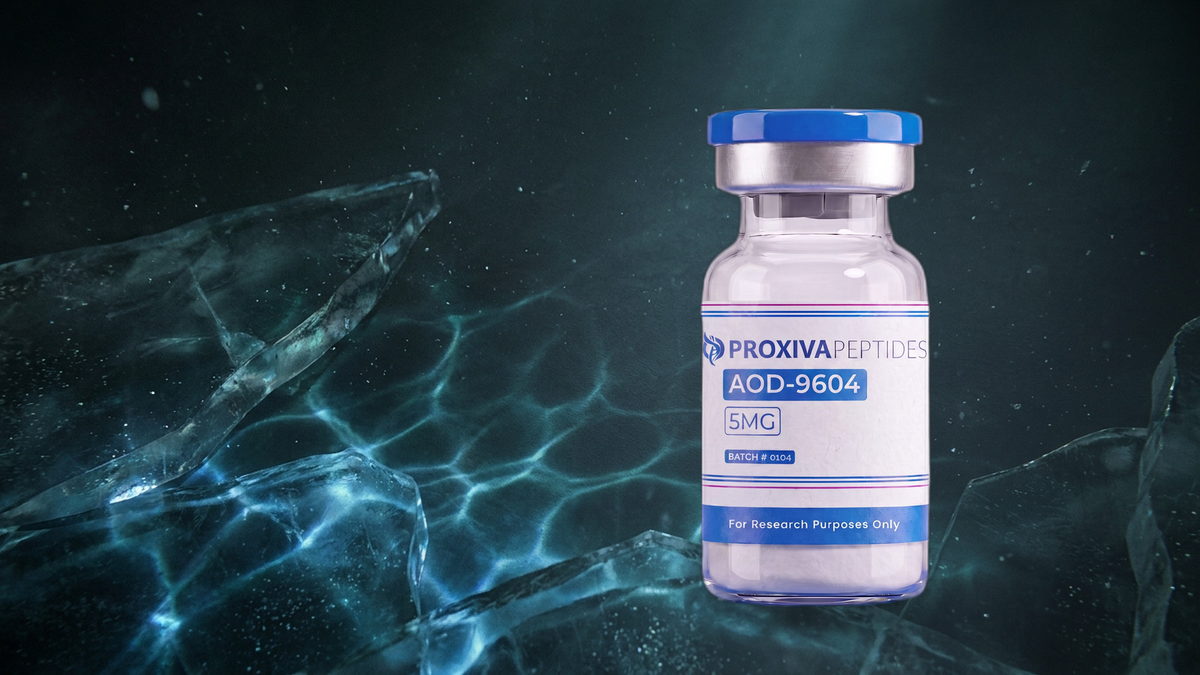
Step 1 — establish which kind of molecule you are buying
Do this first. Do not skip it.
Ask one question. Was this molecule cut from something larger, or was it read out of a genome?
The answer decides everything downstream. Verification. Claim assessment. What evidence counts.
- Check the origin. AOD-9604 is a fragment. It was excised from a much larger hormone.
- Check the other. MOTS-c is not a fragment. It is transcribed from mitochondrial DNA.
- Never treat a fragment claim and a parent claim as the same claim. They are not.
- Confirm what the fragment retained. Do not assume it kept anything.
- Read the origin before you read the marketing. The marketing will not distinguish them.
Understand why this matters. Cut a molecule and you change its size, its shape, its stability, its binding. Some properties survive. Others do not.
Never infer which is which. Establish it.
Apply the same test elsewhere. KPV is a fragment. Selank is a fragment that was then modified. Both carry the same burden. Look for it.
Why two genomes in one cell is worth understanding
The genomic difference between these two is not trivia. It explains why MOTS-c is studied at all.
Mitochondria carry their own DNA, separate from the nucleus — a remnant of their evolutionary origin as free-living organisms absorbed into a larger cell. In humans that genome is small, encoding a modest number of genes, and almost all of them are components of the respiratory chain. It was regarded as a specialised parts list, not a source of signals.
MOTS-c is a sequence found inside that genome that appears to be translated and to act beyond the respiratory machinery. The finding reframed what the mitochondrial genome is for — not merely encoding the machinery, but participating in signalling between the mitochondrion and the rest of the cell.
AOD-9604 comes from the ordinary place. Growth hormone is nuclear-encoded, synthesised in the pituitary, and thoroughly characterised. There is nothing surprising about its location; the interest lies in what the fragment does.
For a buyer the practical consequence is the shape of each literature. AOD-9604 sits downstream of decades of growth-hormone research, so its context is well established even where claims about the fragment itself are thinner. MOTS-c belongs to a category described only recently, so there is less accumulated replication behind any particular finding.
Neither position is better. But they call for different scepticism: with AOD-9604, watch for claims borrowed from the parent. With MOTS-c, watch for claims extrapolated from the novelty of where it was found.
The same contrast runs through the catalogue — Semax and TB-500 are fragments of well-known parents, while MOTS-c stands alone as a complete peptide from an unexpected source.
Step 2 — read the certificate for the right things
Six fields, in the order that catches the most.
- Lot number against the vial. First, always. If they differ, the document describes other material and nothing else on it applies.
- Mass spectrometry. For MOTS-c this is decisive — sixteen residues is specific enough to identify the compound and small enough to measure precisely, so a supplier declining to provide it has no technical excuse. For AOD-9604 it is what confirms you have the intended fragment rather than another one.
- The chromatogram, not just the figure. Look at what sits beside the main peak. Both are short enough that a clean single peak is a reasonable expectation.
- Named independent laboratory. Not the facility that made it.
- Residual solvents. TFA, acetonitrile, DMF — inevitable products of solid-phase synthesis, so silence on them is an incomplete document.
- Water and counterion. Both determine how much of the stated 5mg or 10mg is actually peptide. HPLC purity measures neither.
Purity thresholds are the usual ones: 99%+ for quantitative work, 95–98% acceptable for screening, below 95% not suitable for reproducible research. Field detail in how to read a certificate of analysis.

Step 3 — choose the format deliberately
Both are available as lyophilised vials, and MOTS-c additionally as a 60mg pre-filled pen.
| Lyophilised vial | Pre-filled pen | |
|---|---|---|
| State on arrival | Dry powder | In solution |
| Concentration | You set it | Fixed at fill |
| Stability clock | Starts when you reconstitute | Started at manufacture |
| Measurement | Syringe, operator-dependent | Dial, repeatable |
| Long storage | Better | Worse |
| Reconstitution error | Possible | Eliminated |
Take the vial if concentration is a variable in your protocol, if the material will sit before use, or if you want the handling record under your own control.
Take the pen if several people run the same procedure and measurement consistency matters more than adjustability, or if reconstitution has previously cost you material.
Ask any pen supplier when it was filled. The contents have been dissolved since then, and the label rarely says. Willingness to answer is itself informative. Full trade-off in pens versus vials.
Step 4 — handle them identically
Neither carries a compound-specific liability like the methionine oxidation that affects Semax. Standard discipline covers both.
On receipt
- Match the lot number on the vial against the certificate
- Inspect — white to off-white lyophilised cake is expected; a small fill in a larger vial may appear as a thin film, which is normal
- Into cold storage promptly. Transit heat is cumulative and nothing recovers it
At reconstitution
- Room temperature before opening, so moisture does not condense onto cold powder
- Swab the stopper and let it dry
- Bacteriostatic water for any vial punctured more than once
- Diluent down the inside wall — never a direct stream onto the cake
- Swirl or roll to dissolve; do not shake
- Label immediately with the date and the volume used
Afterwards
- Refrigerate, protected from light
- Swab before every subsequent draw, not only the first
- Never re-freeze — the damage is cumulative and invisible
Reasoning behind each step in reconstituting research peptides and storage and stability.
Step 5 — read claims about each with the right filter
Apply a different filter to each, because they overstate in opposite directions.
Reading AOD-9604: strip out the parent. Growth hormone is famous and the fragment borrows that fame. But the region was selected precisely because it separates one activity from the rest — everything else the parent does was deliberately left behind. When a description leans on what growth hormone does, cross it out. What remains is the actual claim about the fragment, and it is usually much thinner.
Reading MOTS-c: separate the discovery from the compound. That the mitochondrial genome encodes signalling peptides genuinely surprised people. That is a finding about the genome. It is not a finding about what this particular peptide does, and a great deal of writing runs the two together.
For both: keep the structural facts, discard the outcome claims. Sequence, length, genomic origin and derivation are verifiable from a certificate. Effects are not verifiable from anything a supplier can hand you.
Researchers working across these areas commonly also hold NAD+, SS-31, 5-Amino-1MQ, L-Carnitine, Glutathione, SLU-PP-332 and Epithalon, with BPC-157, TB-500, GHK-Cu, Ipamorelin and Tesamorelin in broader panels. Supplier assessment is in choosing a research peptide supplier.
Frequently asked questions
What is AOD-9604 a fragment of?
Human growth hormone — a short region near the C-terminus of the 191-residue protein.
What makes MOTS-c different?
It is encoded in mitochondrial DNA rather than the nuclear genome, and it is a complete peptide rather than a fragment of something larger.
Why does fragment-versus-whole matter for verification?
A fragment can be confused with its parent or with another fragment of the same parent. A complete short peptide has no such ambiguity — which is why TB-500 is routinely sold ambiguously and MOTS-c is not.
Which needs mass spectrometry more?
Both benefit, but MOTS-c at 16 residues sits in a range where the result is decisive rather than suggestive. A supplier declining to provide it for a peptide that length has no technical excuse.
Should I buy the vial or the pen?
Vial for adjustable concentration and long storage; pen for measurement repeatability. A pen's contents have been in solution since manufacture, so ask when it was filled.
Does a fragment inherit its parent's properties?
No. It inherits whatever activity resides in the region retained — which is usually why that region was selected. Descriptions leaning on the parent's reputation are making an inference the chemistry does not support.
Why does the mitochondrial genome matter here?
It was regarded as a parts list for the respiratory chain, not a source of signalling peptides. Finding one there reframed what that genome is for — and that reframing is a large part of why MOTS-c is studied.
Which literature is better established?
Neither cleanly. AOD-9604 sits downstream of decades of growth-hormone research, so its context is solid even where claims about the fragment are thinner. MOTS-c belongs to a recently described category with less accumulated replication.
What should I watch for in claims about each?
With AOD-9604, reputation borrowed from growth hormone — the fragment was selected to separate one activity from the rest. With MOTS-c, extrapolation from the novelty of where it was found, which is not evidence about what it does.
Related research compounds
- Semax Full Kit (10 Vials) — 20% Off — $200
- CJC-1295 No DAC — $62
- GHK-Cu Pen 300mg/3ml — $300
- Melanotan II (MT-II) — $50
- Glow Full Kit (10 Vials) — 20% Off — $696
- GLP3 - R Pen 60mg/3ml — $450
Further reading
Research use only. All products referenced on this page are sold strictly for laboratory and research purposes. They are not drugs, foods, cosmetics, or medical devices, and they are not intended to diagnose, treat, cure, or prevent any disease. They are not for human or veterinary consumption. Handling should be performed only by qualified individuals in an appropriate laboratory setting.