
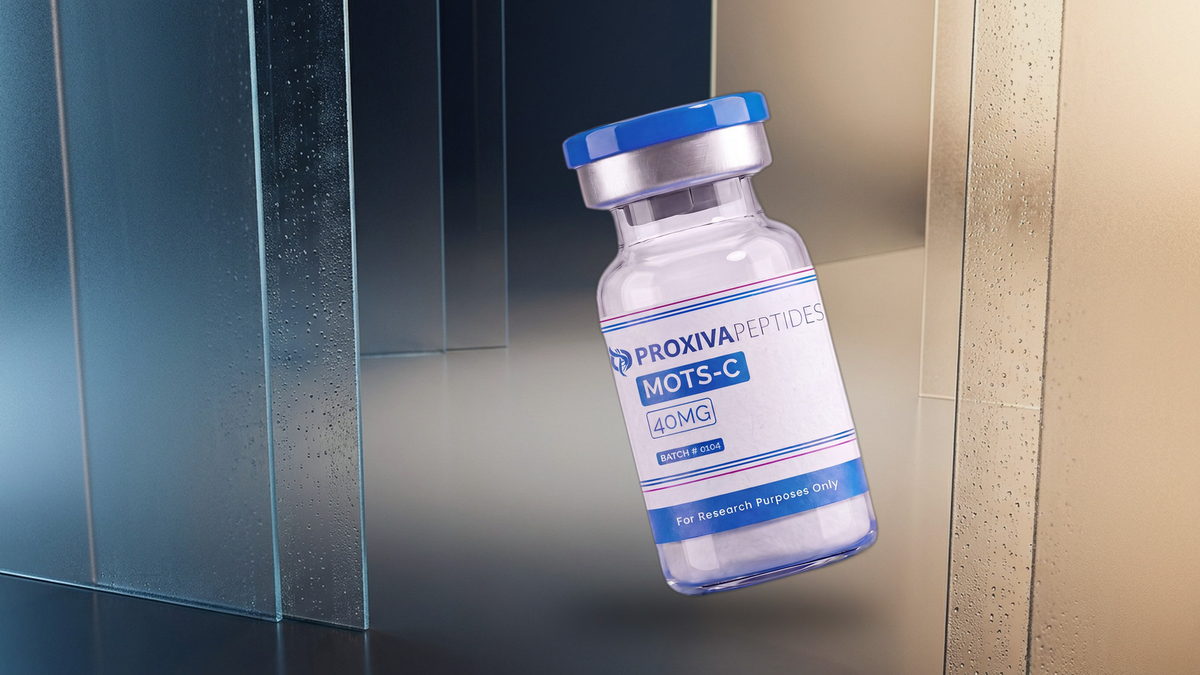
One vial holds a single 16-residue peptide encoded in mitochondrial DNA. The other holds four different peptides at a ratio someone else chose. Comparing MOTS-c to KLOW is not comparing two compounds — it is comparing a compound to a mixture, and almost everything that follows comes from that.
Proxiva Formulation DeskBlends, fill weights and multi-component products
Key takeaways
- One is a single entity. The other is a four-component preparation. That difference is formal, not a matter of degree.
- For a single entity, identity and specification are one claim. For a preparation, they are two, and only one gets tested.
- A certificate can confirm four components present and pure while quantifying none. That verifies an ingredient list.
- Ratios are fixed at manufacture. Reconstitution scales all four together. No later operation recovers independent control.
- Component literatures exist. Combination literature does not. Klow was assembled, not discovered.
The category error this comparison usually makes
The two items placed in opposition here are not comparable objects, and the reason is formal rather than a matter of degree. One is a single molecular entity carrying a defined sequence and a single specification. The other is a four-component preparation whose specification consists of a set of quantities and the ratios holding between them.
That distinction propagates through every subsequent question. Identity, for a single entity, constitutes one claim, and establishing it establishes what the material is. Identity, for a multi-component preparation, constitutes four claims — and establishing all four still leaves the specification untested, because a certificate may confirm the presence and purity of every component without quantifying any of them.
The operative consequence is that verification adequate for the former is structurally insufficient for the latter. The difference does not lie in the degree of care required. It lies in an additional class of measurement being necessary, which no amount of diligence applied to the wrong measurement can supply.
MOTS-c is a sixteen-residue peptide encoded within mitochondrial DNA — a genome long held to encode a small and fixed set of components, and the identification of short reading frames within it yielding functional peptides represents a recent revision to that understanding.
Klow is an assembled preparation containing GHK-Cu at 50mg, TB-500 at 10mg, BPC-157 at 10mg and KPV at 10mg, totalling 80mg. Its components were selected rather than discovered together, and no study has examined the combination as a formulation.
What is actually in each vial
| MOTS-c | KLOW | |
|---|---|---|
| Contents | One peptide, 16 residues | Four peptides |
| Composition | MOTS-c | GHK-Cu 50 · TB-500 10 · BPC-157 10 · KPV 10 |
| Encoded where | Mitochondrial DNA | Nuclear-encoded parents / synthetic |
| Ratio | Not applicable | Fixed at manufacture, 50:10:10:10 |
| Studied mechanism | Mitochondrial signalling | Four unrelated mechanisms |
| Isolation if a batch is bad | Affects one compound | Affects all four |
MOTS-c is one of a small group of mitochondrial-derived peptides — sequences found inside the mitochondrion's own small genome that appear to be translated and act beyond the respiratory machinery. That location is what makes it interesting; nearly everything else in a research catalogue is nuclear-encoded or wholly synthetic.
KLOW is a packaging decision rather than a molecule. Every property it has is a property of its four constituents, and there is no separate literature on the mixture itself.
Why the blend exists at all
Because its four components act through mechanisms that do not overlap — matrix remodelling, actin dynamics, angiogenic signalling and inflammatory signalling. A protocol examining tissue models often wants several at once rather than choosing between them.
The arithmetic supports it too. Bought as separate vials those four come to roughly $275; the blend lists at $190. About 31% less, and three fewer reconstitutions.
None of that logic applies to MOTS-c, which addresses a different question entirely. If your work concerns mitochondrial signalling, the blend contains nothing relevant — and if it concerns tissue repair, MOTS-c is not the compound.
So the honest framing is not which is better but which question you are asking. Full blend breakdown in what is KLOW.

The verification asymmetry
A single compound and a mixture are not held to the same documentation standard — the mixture needs more, and usually gets less.
For MOTS-c, sixteen residues sits in a range where mass spectrometry is decisive rather than suggestive: specific enough to identify the compound, small enough to measure precisely. One clean result settles identity.
For KLOW, a single combined purity figure describes an average. It cannot distinguish a mixture where all four components are excellent from one where three are and the fourth is not.
That matters more here than for most blends because of the cost spread inside it. TB-500 runs about $13.00 per milligram standalone against GHK-Cu's $0.80 — sixteen-fold. A supplier under price pressure would economise on the expensive one, and the combined figure is exactly where that hides.
The chromatogram cannot rescue it either. A blend produces multiple peaks by design, so you cannot tell an expected component from an unexpected impurity by looking — each has to be identified by mass.
And GHK-Cu drags in a requirement of its own: HPLC does not detect metals, so its copper needs a separate determination. Without one, 63% of the product by mass is unverified whatever the headline says. Detail in how to read a certificate of analysis.
Reconstitution: a blend takes a choice away
This is where the two formats diverge most sharply in practice, and the difference is structural rather than a matter of technique.
A single-component vial presents one decision. Concentration is fill weight divided by whatever volume is added, so the volume is chosen to suit the resolution of the measurement being made and nothing else constrains it. Wanting a more dilute working solution simply means adding more diluent.
A blend presents the same decision but attaches four consequences to it. One volume sets the concentration of every component at once, and the proportions between them were fixed at manufacture and cannot be altered afterwards. The volume that gives a convenient concentration for the largest component gives a proportionally smaller one for the rest, and there is no volume that optimises for more than one.
The practical rule is to identify which component the work is actually measuring against and choose the volume for that one, accepting whatever the others become. Attempting to compromise between them produces a solution that is inconvenient for every component rather than convenient for one.
Two secondary points follow. Reconstituting more than the work will consume wastes all four components rather than one, which makes the cost of over-preparing a blend meaningfully higher. And a blend containing a copper complex is more light-sensitive than a plain peptide solution, so the prepared volume should be protected accordingly.
Handling
MOTS-c is unremarkable: sixteen residues, no notable oxidation liability, ordinary discipline entirely sufficient. It is also available as a pre-filled pen, which removes reconstitution at the cost of a fixed concentration.
KLOW inherits its strictest component's requirements, and since you cannot know which that is, the strictest applies to all of it. In practice that means genuine darkness — the blend is mostly GHK-Cu, and copper complexes are more photosensitive than plain peptides.
One consequence specific to mixtures: because the components cannot be separated after reconstitution, a handling error costs all four at once. That raises the value of correct technique rather than relying on a margin.
Both share the rule most often broken — never re-freeze. The damage is cumulative and invisible.
Reasoning in storage and stability. The closely related GLOW blend is KLOW without the KPV, compared in GLOW versus KLOW.
Researchers in these areas commonly also hold NAD+, SS-31, Epithalon, 5-Amino-1MQ, BPC-157, TB-500, GHK-Cu, KPV, Semax and Glutathione. Supplier assessment in choosing a research peptide supplier.
What the mitochondrial genome contributes
One structural point that distinguishes MOTS-c from every component of the blend, and from nearly everything else in a catalogue.
Mitochondria retain their own DNA — a remnant of their origin as independent organisms absorbed into a larger cell. In humans that genome is small and encodes a modest set of genes, almost all of them components of the respiratory chain. It was treated as a parts list for cellular energy production, not as a source of signals.
MOTS-c is a sequence found inside it that appears to be translated and to act beyond that machinery. The finding reframed what the mitochondrial genome is understood to do — participate in signalling between the organelle and the rest of the cell, rather than simply encode its own hardware.
Every component of KLOW comes from the ordinary place. GHK-Cu was identified in human plasma; TB-500 derives from a nuclear-encoded protein present in most cell types; BPC-157 from a gastric protein; KPV from alpha-MSH. Nothing about their location is remarkable.
Two consequences for a buyer. First, the literatures differ in maturity — mitochondrial-derived peptides are a recent category with less accumulated replication, so structural facts about MOTS-c are solid while outcome claims are less settled than confident descriptions imply. Second, novelty is not evidence. That the mitochondrial genome encodes signalling peptides is genuinely surprising and says nothing about what any particular one does.
Applied consistently, that filter removes most of what circulates about MOTS-c and leaves a smaller, better-supported core — the appropriate basis for a research decision. The same discipline applied to the blend is covered in peptides for healing.
Frequently asked questions
Are these comparable products?
No. The comparison is formally ill-posed. One is a single entity with a defined sequence. The other is an assembled preparation defined by quantities and ratios.
What must a blend certificate show?
Quantity per component, reconciled against the stated total. Presence and purity establish the ingredient list and leave the specification untested.
Can ratios be adjusted after purchase?
No. Proportions are fixed at manufacture. Reconstitution scales every component together. Independent variation requires individual vials.
What makes MOTS-c structurally notable?
It is encoded within mitochondrial DNA. That genome was long held to encode a small fixed set of components, and functional peptides from short reading frames are a recent revision.
Is the combination evidenced?
Not as a combination. The four components carry separate literatures of uneven weight. No study has examined them together at these ratios.
Which is harder to verify?
The preparation, categorically. It needs an additional class of measurement. Diligence applied to identity testing cannot substitute.
Related research compounds
Further reading
Research use only. All products referenced on this page are sold strictly for laboratory and research purposes. They are not drugs, foods, cosmetics, or medical devices, and they are not intended to diagnose, treat, cure, or prevent any disease. They are not for human or veterinary consumption. Handling should be performed only by qualified individuals in an appropriate laboratory setting.