
These two represent opposite philosophies. AOD-9604 was cut out of a molecule that already existed in the body — take a hormone, find the active region, discard the rest. SLU-PP-332 was built — designed and screened against a target from scratch. Neither approach is better. They produce very different products.
Proxiva Sourcing DeskSupplier assessment and procurement
Key takeaways
- AOD-9604 is a fragment of human growth hormone — the C-terminal region — supplied as a lyophilised peptide.
- SLU-PP-332 is a designed small molecule, supplied as 250mcg × 100 oral tablets.
- The fragment approach keeps a natural sequence. The design approach can produce something orally available, which peptides generally are not.
- That difference dictates format: one needs reconstitution and a syringe, the other is pre-dosed and swallowed.
- Their certificates should look different — a sequence for one, a chemical structure for the other.
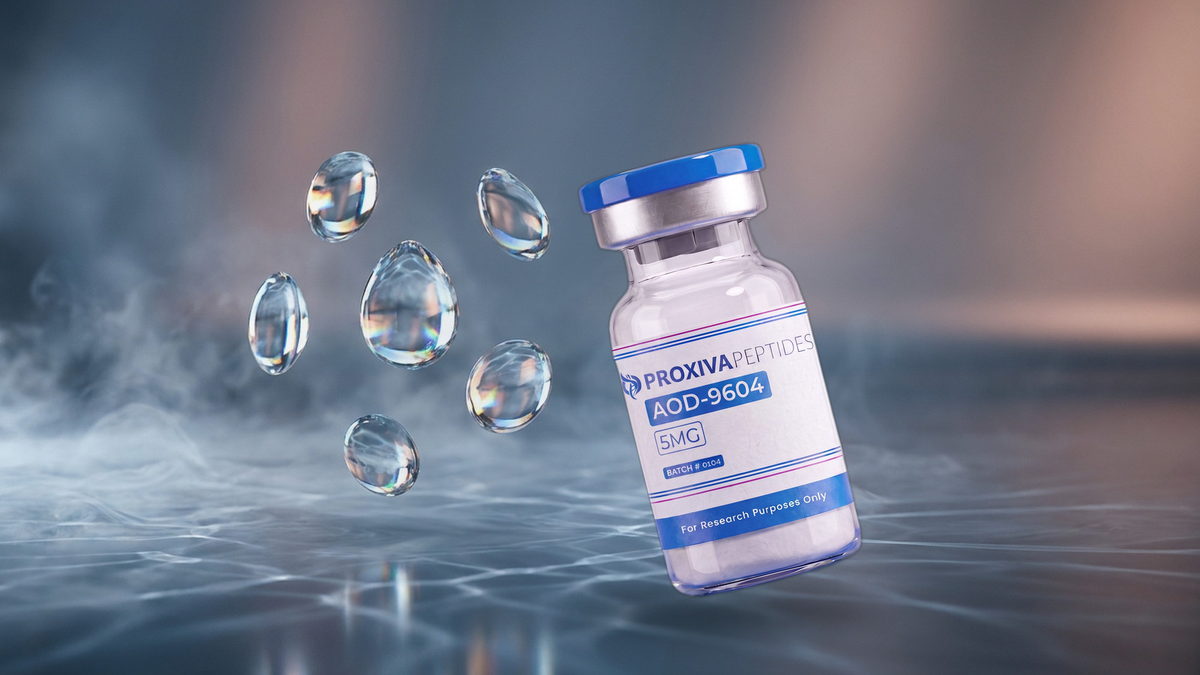
Two opposite ways to arrive at a compound
Most of what separates these two follows from how each came into existence.
AOD-9604 — subtraction
Human growth hormone is 191 amino acids. AOD-9604 corresponds to a short region near its C-terminus. The logic of fragment work is straightforward: if a large protein has several activities and you want one of them, find the region responsible and use only that.
The advantage is that you begin with a sequence evolution already produced, which binds its target because it was built to. The constraint is that you inherit the properties of a peptide — including, critically, the fact that peptides do not survive the digestive tract.
SLU-PP-332 — construction
The opposite route. Pick a target, screen or design molecules against it, optimise the ones that work. Nothing about the result needs to resemble anything biological.
That freedom is the point. A designed small molecule can be shaped for the properties a peptide cannot have — small enough and lipophilic enough to cross the gut wall, and with no amide backbone for digestive proteases to cleave. Which is precisely why it arrives as a tablet.
The format difference, and where it comes from
AOD-9604 arrives as powder in a vial. SLU-PP-332 arrives as 100 tablets. That is not a packaging decision — it follows from what each molecule is, and the underlying chemistry is worked through in MOTS-c versus SLU-PP-332, which covers the same peptide-versus-small-molecule divide.
What matters for this pairing is narrower: AOD-9604 is a fragment of something, and SLU-PP-332 is not a fragment of anything.
| AOD-9604 | SLU-PP-332 | |
|---|---|---|
| Came from | A 191-residue human hormone | Designed against a target |
| Relationship to a parent | A piece of one | None |
| Sequence exists? | Yes — inherited | No |
| Supplied as | 5mg lyophilised vial | 250mcg × 100 tablets |
| Doses per unit | Set by your dilution | 100, fixed |
That parent relationship is the axis worth thinking about. A fragment carries an inherited reputation it did not earn — growth hormone is famous, so a fragment of it borrows that fame while having been deliberately separated from most of what the parent does.
A designed molecule has no inherited reputation at all. Whatever is claimed for it has to stand on its own evidence, because there is no famous parent to gesture at. That is a harder sales proposition and, for a buyer, a cleaner one to evaluate.
What that means for verification
Their certificates should not resemble each other, and a mismatch is diagnostic.
AOD-9604 is identified against a theoretical mass calculated from its amino-acid sequence. Purity by HPLC, identity by mass spectrometry, residual solvents from solid-phase synthesis — TFA, acetonitrile, DMF — plus counterion and water content, which determine how much of the stated 5mg is actually peptide.
SLU-PP-332 has no sequence. Identity is confirmed against a molecular formula, or better by NMR, which reports on structure rather than only on mass. Residual solvents will reflect a different synthetic route entirely.
The tell: a certificate reporting an amino-acid sequence for SLU-PP-332 was produced from a peptide template, not from analysis. It cannot have one. That single observation should govern how much weight you give the rest of the document.
And the tablet raises a question the vial does not: content uniformity. A bottle of 100 units is only as good as its consistency across those units. It is a standard measure and its absence on a tablet certificate is a real gap, not a formatting choice.
Field-by-field guidance in how to read a certificate of analysis.

What can and cannot be checked about each
Both compounds attract confident description online. It is worth separating what a buyer can actually verify from what they are being asked to take on trust.
Verifiable
That AOD-9604 corresponds to a defined region of human growth hormone is checkable — the sequence is known and a mass-spectrometry result either matches the theoretical figure or it does not. That SLU-PP-332 is a small molecule with a defined structure is likewise checkable by NMR or by mass against its molecular formula.
Purity is verifiable for both. Residual solvents, counterion, water content, batch traceability — all measurable, all reportable, all routinely omitted.
Not verifiable by you
Everything about what either does. Both are supplied as research materials, both are studied in metabolic contexts, and the published work on each is predominantly cell-culture and animal-model research. A buyer cannot check any of it from a certificate, because certificates report on chemistry, not on outcomes.
That asymmetry is the useful frame. A supplier can prove what a vial contains. No supplier can prove what it does — and one that describes outcomes anyway has told you something about the rest of its documentation before you read a line of it.
The specific gap on fragments
AOD-9604 carries one extra evaluation problem. Descriptions of fragments routinely borrow the parent molecule's reputation — growth hormone is well known, so a fragment of it inherits an aura the fragment itself has not earned. The active region was selected precisely because it separates one activity from the rest, which means the parent's other properties were deliberately left behind.
Where a description of AOD-9604 leans on what human growth hormone does, it is describing something the fragment was designed not to be.
Handling
One of these needs technique. The other needs a dry cupboard.
AOD-9604 arrives as powder and the reconstitution step is where material is most often lost — diluent injected straight onto the cake rather than down the wall, shaking instead of swirling, an unlabelled vial that becomes unusable a fortnight later because nobody recorded the concentration. None of that is difficult; all of it is easy to get wrong once. The full sequence is in reconstituting research peptides.
SLU-PP-332 removes the entire category. Tablets in a sealed bottle, dry and out of direct light.
What the tablet costs you is inspection. A lyophilised cake tells you something on sight — colour, form, whether it looks the way it should. A coated tablet reveals nothing at all, so the certificate carries proportionally more weight for the compound you can least examine.
That is a fair trade for anyone confident in their documentation and a poor one for anyone buying on price from an unfamiliar supplier.
Pricing two different units
One is sold by weight of powder, the other by count of tablets. There is no exchange rate between those, and any source offering one is inventing it.
For the vial, cost per experiment is a function of your own dilution — the number is not fixed until you decide it. For the tablets, cost per unit is division, but only meaningful if 250mcg is a quantity your protocol wants.
The adjustment that applies to both and is almost never made: ask whether the stated weight is net compound. A vial's figure includes water and counterion; a tablet's includes excipients. HPLC purity measures none of that, so both headline numbers overstate active material — by different amounts, in different ways.
Compare total material against total cost, say plainly that the units differ, and stop there.
Frequently asked questions
What is AOD-9604 a fragment of?
Human growth hormone — specifically a short region near the C-terminus of the 191-residue protein.
Is SLU-PP-332 a peptide?
No. It is a designed small molecule supplied as 250mcg oral tablets. It has no amino-acid sequence, which is why a certificate reporting one was generated from a template rather than from analysis.
Why is one oral and the other not?
Peptides are chains of amide bonds — the bonds digestive proteases break. Small molecules have no such backbone and can be designed for gut absorption, so oral dosing is available to them and structurally is not to a peptide.
Can I compare them on price?
Not directly. One is priced per vial of powder you dilute yourself, the other per bottle of 100 fixed-dose tablets. Total material against total cost is the only fair framing.
What should a tablet certificate include that a vial's does not?
Content uniformity across the 100 units. A single vial raises no such question; a bottle of tablets does, and its absence is a genuine gap.
Does a fragment inherit the parent hormone's function?
Not automatically. It inherits whatever activity resides in the region retained — which is usually why that particular fragment was selected in the first place.
Related research compounds
- Bacteriostatic Water — $12.00
- Melanotan II Full Kit (10 Vials) — 20% Off — $200
- Slupp Full Kit (10 Bottles) — 20% Off — $800
- Tesa-morelin — $90
- MOTS-C Pen 60mg/3ml — $250
- CJC No DAC + Ipamorelin Full Kit (10 Vials) — 20% Off — $360
- GHK-Cu Full Kit (10 Vials) — 20% Off — $160
- Wolverine Blend Full Kit (10 Vials) — 20% Off — $380
- PT-141 Full Kit (10 Vials) — 20% Off — $240
- KPV – 10mg — $50
- CJC-1295 No DAC — $62
- BPC-157 — $36.00
- DSIP Full Kit (10 Vials) — 20% Off — $256
- Selank Full Kit (10 Vials) — 20% Off — $240
- Tesa-morelin Pen 30mg/3ml — $350
- Glow Full Kit (10 Vials) — 20% Off — $696
- NAD+ — $50
- AOD-9604 Full Kit (10 Vials) — 20% Off — $324
Further reading
Research use only. All products referenced on this page are sold strictly for laboratory and research purposes. They are not drugs, foods, cosmetics, or medical devices, and they are not intended to diagnose, treat, cure, or prevent any disease. They are not for human or veterinary consumption. Handling should be performed only by qualified individuals in an appropriate laboratory setting.