
GHK-Cu is not a conventional peptide and should not be verified like one. It is a tripeptide-copper complex, and the copper is not an impurity or an additive — it is a structural component of the molecule. That single fact changes what a certificate of analysis needs to demonstrate.
Proxiva Comparative ReviewCompound-versus-compound analysis
Key takeaways
- GHK-Cu is glycyl-L-histidyl-L-lysine complexed with a copper(II) ion. The complex is the compound; uncomplexed GHK is a different material.
- Purity by HPLC does not establish copper content. A vial can be 99% pure GHK and carry little or no copper — the standard peptide test will not detect that.
- Copper content should be reported separately, typically as a percentage by mass or a molar ratio against the peptide.
- The complex is light-sensitive to a degree that plain peptides are not. Dark storage matters more here.
- Per milligram it is among the least expensive research peptides, which is why it dominates blends such as GLOW and KLOW by mass.
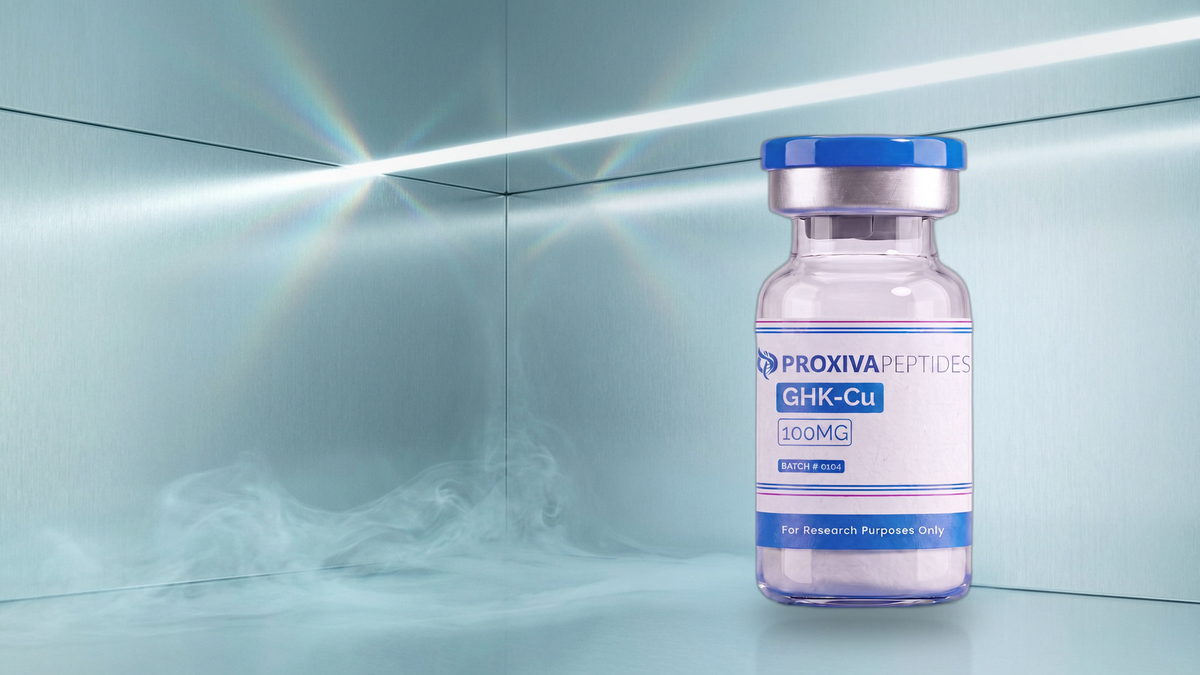
Formats and pricing at a glance
| Product | GHK-Cu content | Price | Notes |
|---|---|---|---|
| GHK-Cu 50mg | 50mg | $40 | Standalone, lyophilised |
| GHK-Cu 100mg | 100mg | $70 | Standalone, better per mg |
| GLOW 70mg | 50mg | $174 | With TB-500 10mg, BPC-157 10mg |
| KLOW 80mg | 50mg | $190 | GLOW plus KPV 10mg |
| GLOW pen | proportional | $250 | Pre-filled, 130mg total |
| KLOW pen | proportional | $300 | Pre-filled, 145mg total |
The 100mg standalone vial is the better per-milligram purchase — $0.70/mg against $0.80/mg for the 50mg. That is a modest difference but it runs the correct direction, which is not always true of larger fills.
Prices are as listed at time of writing. What follows concerns verification, which does not change.
Why the copper changes the verification problem
GHK is a tripeptide: glycine, histidine, lysine. GHK-Cu is that tripeptide bound to a copper(II) ion. The histidine residue provides the primary coordination site, and the resulting complex is what the research literature concerns.
This creates a verification gap that standard peptide testing does not close.
HPLC with UV detection measures organic material. It will confirm that the peptide portion is present and quantify organic impurities. It will not tell you whether the copper is there, because the metal is not what the detector is looking at. A vial containing 99% pure GHK with no copper whatsoever would return an excellent purity figure.
Mass spectrometry helps but is not automatically sufficient either — the complex and the free peptide have different masses, so the result can distinguish them, but only if the method was run in a way that preserves the complex and only if the reported value is interpreted against the correct theoretical mass.
The direct answer is a separate copper determination. This is a routine analytical measurement and a supplier taking the compound seriously will have it.

Where the compound comes from
GHK was first identified in human plasma, where it occurs naturally, and the copper-binding property was characterised subsequently. This origin distinguishes it from most compounds in a research catalogue, which are synthetic constructs or engineered analogues rather than endogenous molecules.
The tripeptide's affinity for copper is high and specific. Histidine's imidazole side chain is a well-known metal coordination site in biochemistry generally, and in GHK it combines with the peptide backbone to form a stable complex with copper(II).
Because the complex forms readily, GHK and copper supplied separately will associate in solution. That is chemically true and commercially misleading — it is sometimes used to justify selling free peptide as though it were equivalent to the complex. The stoichiometry, stability and purity of a complex formed under controlled synthesis conditions are not automatically reproduced by mixing components in a vial.
The research literature on GHK-Cu is comparatively substantial for a research-catalogue compound, spanning several decades, with much of it concerning matrix remodelling and gene-expression effects in cell culture. This is unusual — many compounds in this market rest on far thinner published foundations, as our comparison of Semax and Selank discusses.
For buyers, the practical significance is that claims about GHK-Cu can more often be traced to primary sources than claims about most catalogue compounds. That makes it easier to distinguish supported statements from marketing than it is elsewhere.
What the certificate should carry
Everything required for any research peptide, plus one addition:
- HPLC purity — with the chromatogram image, not just a percentage
- Mass-spectrometry identity — interpreted against the complex, not free GHK
- Copper content — reported as percentage by mass or molar ratio. This is the field specific to this compound and the one most often missing
- Batch number matching the vial label exactly
- Named testing laboratory, independent of the synthesis facility
- Residual solvents — TFA, acetonitrile, DMF
- Appearance — the complex has a characteristic blue colour
The appearance line is worth more here than for most compounds. A copper complex is coloured; free peptide is not. Material that arrives white or off-white when it should be blue is telling you something before any document does. This is one of the few cases where visual inspection carries real diagnostic weight.
Our full walkthrough of certificate fields is in how to read a peptide certificate of analysis.
Storage — stricter on light than most
Copper coordination complexes are generally more photosensitive than plain peptides, and they can also participate in redox chemistry that ordinary peptides do not.
The practical consequence is that the dark-storage instruction, which is good practice everywhere, is closer to a requirement here.
- Sealed lyophilised vial, cold and genuinely dark — amber glass or a closed opaque container
- Reconstitute with bacteriostatic water for multi-draw vials
- Add diluent down the vial wall; swirl rather than shake
- Refrigerate afterwards, label with date and volume
- Never re-freeze reconstituted material
- Watch for colour change — loss or shift of the blue coloration indicates the complex has changed
That last point is a genuine advantage of this compound. Most peptide degradation is invisible; here, a change in the complex often is not. It is not a complete assay, but it is a free signal most compounds do not offer.
General principles are covered in peptide storage and stability.
Buying standalone or inside a blend
GHK-Cu appears in this catalogue both on its own and as the dominant component of two blends, and the choice between them is worth making deliberately rather than by default.
Standalone makes sense when GHK-Cu is what you want, when quantity needs to be adjusted independently, or when you want its documentation verified in isolation rather than bundled with three other compounds.
The blends make sense when you want the full combination anyway. As covered in our GLOW versus KLOW comparison, both are meaningfully cheaper than assembling the same components separately — roughly 23% for GLOW and 31% for KLOW.
What you give up in a blend is isolation. Because GHK-Cu is 50mg of a 70mg or 80mg total, a copper-content problem in the blend affects most of the vial's mass, and there is no way to separate it from the TB-500, BPC-157 or KPV sharing the vial.
For a first order from an unfamiliar supplier, buying the standalone vial and verifying its copper content before committing to a blend is the more cautious sequence.
Comparing suppliers on this compound specifically
Two questions separate suppliers who understand this compound from those reselling it.
"What is the copper content, and how was it determined?" A supplier with a real answer names a method. A supplier without one will typically redirect to the HPLC purity figure, which does not answer the question asked.
"Is the stated milligram figure the complex or the peptide?" The copper contributes mass. Whether a 50mg fill means 50mg of complex or 50mg of peptide plus copper is a real ambiguity, and it affects the per-milligram comparison directly.
Neither question is unreasonable and both are answerable by anyone handling the compound properly. As with everything in this market, the willingness to answer is itself informative — a point developed further in our guide to choosing a research peptide supplier.
Researchers stocking GHK-Cu commonly hold related material alongside it — BPC-157, TB-500, KPV, Glutathione, Epithalon, NAD+, Ipamorelin, Semax, Selank, MOTS-c, PT-141 and Melanotan II among them.
Frequently asked questions
What is GHK-Cu?
A tripeptide — glycine, histidine, lysine — complexed with a copper(II) ion. The copper is a structural component of the molecule rather than an additive, and the complex is what the research literature concerns.
Does HPLC purity confirm the copper is present?
No. HPLC with UV detection measures organic material and does not see the metal. A vial of 99% pure GHK with no copper at all would return an excellent purity figure. Copper content needs separate determination.
What should the COA report for GHK-Cu?
Everything required for any peptide, plus copper content stated as a percentage by mass or a molar ratio. That field is specific to this compound and is the one most often absent.
Why does colour matter?
The copper complex is blue; free peptide is not. Material arriving white or off-white, or losing its coloration in storage, is signalling a change in the complex. Most peptide degradation is invisible — this is a rare case where it may not be.
Is it cheaper inside GLOW or KLOW?
The blends are cheaper than assembling their components separately, but you cannot isolate the GHK-Cu. For verifying a new supplier, the standalone vial is the more cautious first purchase.
Which standalone fill is better value?
The 100mg vial at $70 works out to $0.70/mg against $0.80/mg for the 50mg at $40.
Related research compounds
Further reading
Research use only. All products referenced on this page are sold strictly for laboratory and research purposes. They are not drugs, foods, cosmetics, or medical devices, and they are not intended to diagnose, treat, cure, or prevent any disease. They are not for human or veterinary consumption. Handling should be performed only by qualified individuals in an appropriate laboratory setting.