
Buying Klow is unlike buying a single compound, because the name is a convention rather than a specification. No body defines what Klow contains, which means the first thing to establish is not price but composition.
Proxiva Catalogue DeskFormats, presentations and per-milligram economics
Key takeaways
- Where a single-compound purchase is defined by its name, a blend purchase is not, because these names are conventions that no body defines and different suppliers apply to materially different formulations.
- This vial carries GHK-Cu at 50mg, TB-500 at 10mg, BPC-157 at 10mg and KPV at 10mg, whereas the composition published most often elsewhere describes a total under half that size.
- Against its own components at matching vial sizes the blend costs $190 where the parts cost $275, a margin that holds only for a buyer who wanted all four.
- Where a single-component certificate settles identity and specification together, a blend certificate settles them separately, and typically only the first is tested.
- Unlike individual vials, a blend fixes its internal proportions permanently, so work requiring one component to vary against another is foreclosed rather than merely inconvenient.
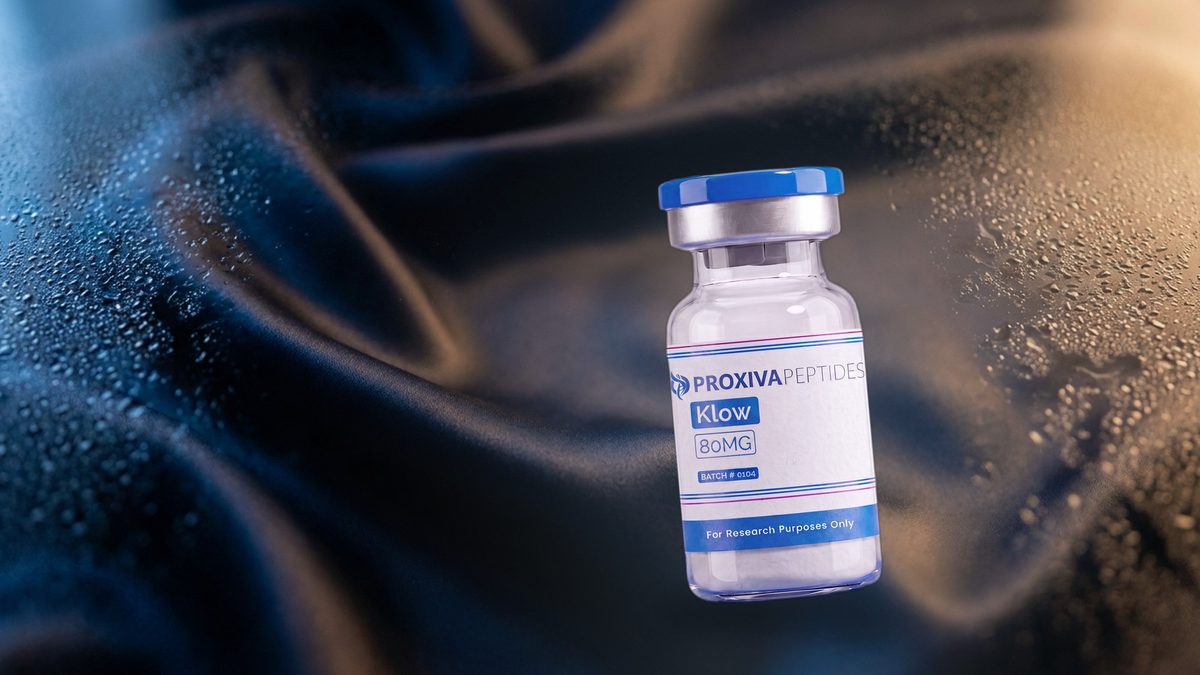
What you are actually buying, side by side
Start here rather than with price, because the comparison that matters is between what different vendors mean by the same word.
| This vial | Commonly published elsewhere | |
|---|---|---|
| GHK-Cu | 50mg | Often 20mg |
| TB-500 | 10mg | Often 5mg |
| BPC-157 | 10mg | Often 5mg |
| KPV | 10mg | Sometimes absent entirely |
| Total peptide | 80mg | Frequently 30-40mg |
The right-hand column is not an accusation against other vendors. Blend names in this category are conventions that nobody owns and nobody defines, so two suppliers can use the same word for materially different products and both be describing their own accurately.
The consequence for a buyer is narrow and important: a price comparison between vendors selling the same blend name is close to meaningless unless total peptide is held constant. A cheaper vial containing half the material is not cheaper, and figures taken from a general article about the blend name do not describe any particular vial.
So the first question to a supplier is not what it costs. It is what is in it, in milligrams, per component.
What the components cost on their own
Against the four components purchased individually, at the vial sizes matching the quantities inside the blend:
| Component | Size | Price |
|---|---|---|
| GHK-Cu | 50mg | $40 |
| TB-500 | 10mg | $130 |
| BPC-157 | 10mg | $55 |
| KPV | 10mg | $50 |
| Four components separately | — | $275 |
| Klow as a blend | 80mg | $190 |
The blend sits $85 below the cost of assembling it. That is the ordinary reason blends exist and it is not remarkable in itself.
What matters more is the condition attached: the saving is real only for a buyer who wanted all four components. If one is unwanted, its cost has not disappeared — it has been bundled where it cannot be declined. Someone who wants only GHK-Cu should buy it directly at $40 rather than paying $190 for a vial in which it is one part of four.
The comparison against Glow is worth running for the same reason. Glow carries three of these four components at the same quantities and costs $174, so the step to the fourth component is $16 — against $50 to buy that component alone.

How to compare two vendors selling the same name
Because the name carries no specification, comparison between suppliers has to be done on the underlying quantities rather than on the label. The procedure is short and it disposes of most of the confusion in this category.
Convert every offer to a cost per milligram of each component, not per vial. A vial is not a unit of anything — it is a container, and containers vary. Two vials at the same price carrying 80mg and 35mg respectively are not two prices for one product; they are two products.
Then check whether the components you actually want are present at quantities that matter to the work. A blend containing a component at a token amount has included it for the ingredient list rather than for any effect, and this is a common pattern precisely because it costs the vendor little and reads well.
Finally, compare what each vendor will document. A supplier that publishes per-component quantities and will produce a batch certificate reporting them is offering something checkable. A supplier that states only a total and a name is offering a claim, and the two should not be weighed against each other as though they were the same kind of thing.
Applied across this catalogue the same reasoning separates Glow from Klow cleanly, and separates both from the two-component blend, which fixes one relationship rather than three. None of those distinctions is visible from the product names alone, which is the entire difficulty with buying in this category.
Verification: the check specific to blends
Standard verification applies, and one additional step does.
Ask for a certificate matched to the batch you received rather than a representative document for the product line. Read identity by mass spectrometry before purity by chromatography, since a purity figure attached to an unconfirmed identity describes a different molecule. Read the trace rather than the headline number.
The additional step is quantitative and is the one most often skipped. A certificate can confirm that four components are present and pure while reporting nothing about their proportions — and for a blend, proportion is the product. Confirm that quantity per component is reported, and that the figures reconcile with the stated total: 50 plus 10 plus 10 plus 10 reaching 80.
A certificate listing components without quantifying them has verified the ingredient list, which is the easy half, and left the specification untested. For a single-component vial such as KPV that gap does not exist, because identity and specification are the same claim. For a blend they are two claims, and typically only one is tested.
There is also a component-specific check here. GHK-Cu is a copper complex rather than a plain peptide, and the complex is the functional species. A certificate establishing the peptide portion without confirming copper content has verified part of the molecule.
What a blend forecloses
One constraint is structural and no supplier can work around it, so it is worth settling before ordering rather than after.
The proportions between components are set at manufacture. Reconstitution changes concentration but scales all four together, so the relationship between them is permanent. Drawing less material means less of everything.
Where the components are wanted in roughly the proportions supplied, this is a convenience — one vial, one reconstitution, one set of handling decisions rather than four. Where the work requires one component to vary while others are held constant, the design is simply unavailable, and the only route is individual vials at a higher total cost that buys a capability the blend does not have.
Intermediate options exist. The two-component blend fixes one relationship and leaves the others free. Glow carries three of the four. Which is appropriate depends entirely on which relationships need to stay adjustable, and that is a question about the work rather than about the product.
Handling on arrival
Lyophilised material is stable under refrigeration and tolerates transit. The useful window shortens considerably after reconstitution, at which point cold storage stops being optional.
Use bacteriostatic water where the vial will be entered more than once; the preservative is what makes repeated withdrawal reasonable. Add it against the vial wall rather than onto the powder and allow dissolution to proceed rather than forcing it.
The copper component introduces a note the others do not. It is what makes the reconstituted solution visibly blue, and the coordinated metal is the part of the mixture most sensitive to careless handling — so light exposure and vigorous agitation are worth avoiding more carefully here than they would be for a plain peptide.
Because a blend concentrates four purchases into one vial, a handling error costs proportionally more than the same error on a single-component vial. That is the small counterweight to the pricing advantage and it is worth stating alongside it.
What is not established
The components have individual literatures of markedly uneven weight. GHK-Cu has by a clear margin the largest and oldest. The others are thinner.
The combination has none as a combination. Klow was assembled rather than discovered, and no study has examined these four components together at these ratios in these quantities. Claims about what the blend does as a blend are extrapolation from the parts.
This is not specific to this vendor or this blend — it applies to every version of it currently sold. The practical consequence is that a claim about the blend can be checked only by tracing it to a component and testing it against that component's evidence at the quantity present. Claims about emergent effects of the combination lead nowhere, because there is nowhere for them to lead.
Frequently asked questions
What does this vial contain?
GHK-Cu at 50mg, TB-500 at 10mg, BPC-157 at 10mg and KPV at 10mg, totalling 80mg, whereas figures published elsewhere for the same blend name frequently describe well under half that quantity.
Why do published compositions differ?
Because no body defines these names, and unlike a pharmacopoeial designation a blend name carries no specification, so two suppliers may apply it to different formulations while each describes its own product accurately.
Is the blend cheaper than its components?
Yes, at $190 against $275 for the four purchased individually at matching sizes, though that margin is a saving only where every component was wanted rather than merely included.
What distinguishes a blend certificate?
A single-component certificate establishes identity and specification in one claim, whereas a blend certificate establishes them separately, and a document confirming four components present and pure has verified the ingredient list while leaving proportions untested.
Can the internal ratios be altered?
No, since they are fixed at manufacture and reconstitution scales all four together, which distinguishes a blend from individual vials in capability rather than merely in convenience.
How does it compare with Glow?
Glow carries three of the four components at identical quantities for $174, so the additional component costs $16 as a step between blends against $50 purchased separately.
Related research compounds
- DSIP – 15mg — $64.00
- SS31 – 10mg — $80
- Selank – 10mg — $60
- Semax – 10mg — $50
- CJC-1295 No DAC — $62
- AOD 9604 – 5mg — $81.00
- L - Carnitine — $55
- Slupp — $200
- GLP2 T — $70
- Tesa-morelin — $90
- Ipamorelin — $40
- Melanotan II (MT-II) — $50
Further reading
Research use only. All products referenced on this page are sold strictly for laboratory and research purposes. They are not drugs, foods, cosmetics, or medical devices, and they are not intended to diagnose, treat, cure, or prevent any disease. They are not for human or veterinary consumption. Handling should be performed only by qualified individuals in an appropriate laboratory setting.