
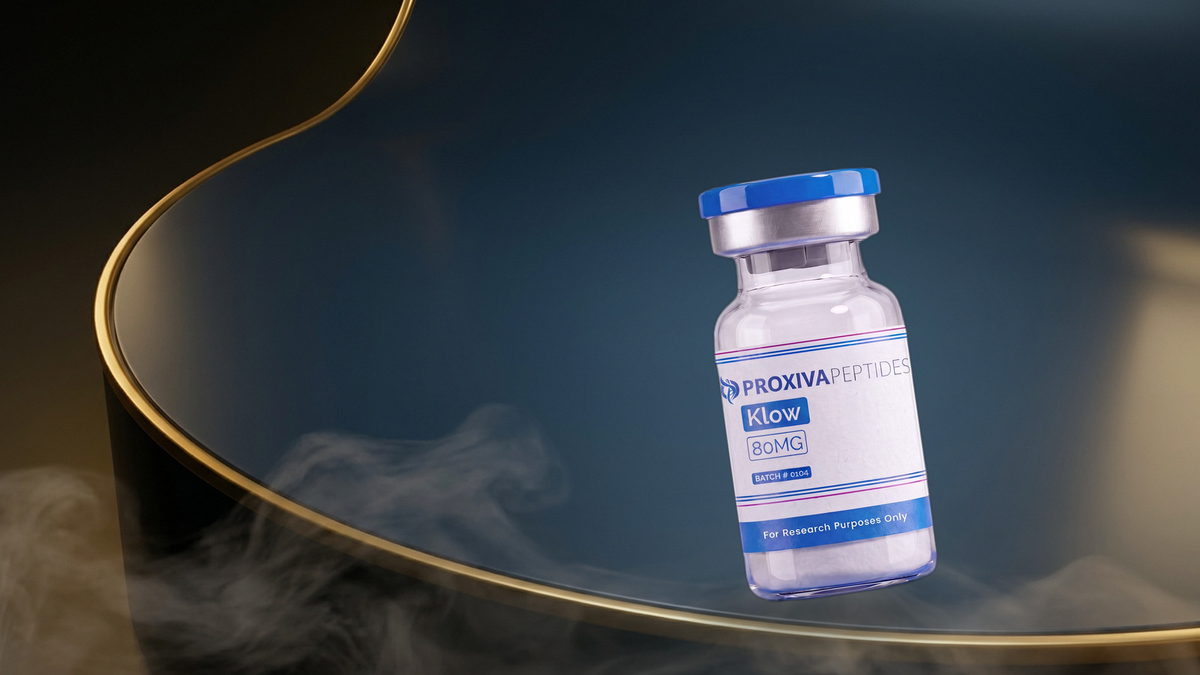
KLOW is sold as a single 80mg vial, which tells you almost nothing about what is in it. Unlike a single-compound product, a blend's headline weight covers several peptides at a ratio the manufacturer chose. This breaks the blend down component by component and compares it against buying the same compounds individually.
Proxiva Formulation DeskBlends, fill weights and multi-component products
Key takeaways
- KLOW is a multi-component blend, not a single compound. The 80mg figure is a combined total across its constituents.
- Its components are drawn from well-characterised research peptides, each with an independent literature — the blend is a packaging decision, not a new molecule.
- Per-milligram comparison against single vials requires knowing the split. Without it, a blend cannot be price-compared to anything.
- A blend fixes the ratio at manufacture. That is a convenience when the ratio is settled and a constraint when it is the variable under study.
- A blend's certificate of analysis should address every component, not just report a combined purity figure.
What a peptide blend actually is
A blend is several lyophilised peptides combined in one vial before freeze-drying, so that reconstituting the vial produces a solution containing all of them at fixed relative proportions.
This is worth stating plainly because blend naming often obscures it. A product called KLOW sounds like a compound. It is a mixture, and every property it has is a property of its constituents.
The consequences follow directly. The literature on a blend is the literature on its components — there is no separate body of research on the mixture itself. Its stability profile is governed by whichever component is least stable. Its verification requirements are the union of the requirements for each part.
This also means anyone describing a blend as though it were a distinct compound with its own characteristics is either confused or selling. Related blends in the same catalogue include GLOW, the BPC-157 and TB-500 combination, CJC-1295 no-DAC with Ipamorelin and Selank with Semax — each following the same logic.
Why the milligram figure is the important question
A single-compound vial listed at 10mg contains 10mg of that compound. An 80mg blend contains 80mg distributed across several compounds in proportions the manufacturer decided.
Until you know that split, several things are impossible:
- Comparing the blend's price against buying the components separately
- Comparing it against a competing blend with different proportions
- Knowing the concentration of any individual component after reconstitution
- Reproducing the same conditions with separately purchased material
The split should be stated on the product listing or the certificate. Where it is not, that absence is itself informative — a manufacturer who has not published the composition is asking to be trusted on the one number that determines value.
This applies equally to the KLOW pen format, where the total is larger but the same question applies.
Reading the arithmetic
With the split known, comparison becomes straightforward. Take the blend's total price, apportion it across components by their milligram share, and compare each against the single-vial price for that compound.
| Blend | Separate vials | |
|---|---|---|
| Total peptide | Stated as one figure | Sum of individual fills |
| Ratio | Fixed at manufacture | Set by you |
| Reconstitutions | One | One per compound |
| Price comparison | Requires the published split | Direct |
| Failure of one component | Affects the whole vial | Isolated to that vial |
| Adjusting one component | Not possible | Straightforward |
The last two rows are the ones most often overlooked. If one component of a blend turns out to be substandard, the entire vial is compromised — there is no way to isolate it. With separate vials, a bad batch of one compound leaves the others untouched.
Against that, the blend genuinely removes work. Multiple reconstitutions mean multiple opportunities for the handling errors described in our guide to reconstituting research peptides, and each one is a chance to lose material.
A blend's certificate against a single vial's
The documentation bar is higher for a mixture than for a single compound, and this is where blends are most often under-served.
| Single vial | Blend | |
|---|---|---|
| Identity | One mass result | One per component |
| Purity | One figure, meaningful | One combined figure, close to meaningless |
| Chromatogram | One dominant peak expected | Multiple peaks by design |
| What a good number hides | Little | A weak component averaged against strong ones |
That second row is the crux. A single combined purity figure cannot separate a mixture where every component is excellent from one where three are and the fourth is not. Given the components have very different standalone costs, the incentive to economise on one of them exists — and a combined figure conceals exactly that.
The chromatogram cannot rescue it either, because a blend produces several peaks legitimately. You cannot tell an expected component from an unexpected impurity by looking at the trace; each has to be identified by mass.
So the questions to ask a blend supplier are narrower than for a single vial: is every component identified individually, is purity reported per component where the method allows, and is the milligram split stated and matching the listing. Everything else — lot match, named independent laboratory, solvent panel — carries over unchanged from the certificate guide.

Handling and stability
A blend's stability is governed by its least stable component. If one peptide in the mixture is vulnerable to oxidation or degrades faster in solution, that constrains the whole vial regardless of how robust the others are.
In practice this means applying the strictest handling any component requires, which — since you may not know which that is — means applying strict handling throughout.
- Sealed lyophilised vial kept cold, dry and out of light
- Reconstitute with bacteriostatic water for any vial punctured more than once
- Add diluent down the vial wall, never onto the powder cake
- Swirl to dissolve; never shake
- Refrigerate afterwards, label with date and volume, and never re-freeze
The reasoning behind each of these is covered in peptide storage and stability. One practical note specific to blends: because you cannot separate components after reconstitution, a handling error costs you all of them at once.
When a blend is the right purchase
The decision comes down to whether the ratio is settled.
If you are running an established protocol where the proportions are already determined and will not change, a blend removes reconstitution steps, reduces handling error, and costs less in labour. Those are real advantages and the reason blends exist.
If the ratio is itself under investigation, a blend is the wrong tool — you cannot vary what is fixed at manufacture. Buy the components separately and set proportions yourself.
There is also a verification argument for separate purchase early on. Buying individual vials of each compound lets you confirm each one's documentation independently before committing to a combined product where a single weak component compromises everything.
For broader catalogue context, single-compound alternatives include BPC-157, TB-500, GHK-Cu, Ipamorelin, Semax, Selank, MOTS-c, Epithalon, NAD+, PT-141, Melanotan II, Glutathione, KPV and DSIP.
Comparing KLOW against GLOW
The two most commonly confused products in this catalogue are KLOW and GLOW, and the similarity of the names does not help.
They are different blends with different compositions and different total weights — 80mg against 70mg — which means they are not interchangeable and cannot be price-compared without the splits for both.
Both are also available in pen format, as the KLOW pen and the GLOW pen, at larger totals again. A full side-by-side is covered in our GLOW versus KLOW comparison.
The general lesson holds for any pair of blends: two products with similar names and similar totals may share no components at all. Read the compositions, not the names.
Blend naming across the industry
Blend names are marketing constructs, and the conventions are worth understanding because they are the main source of confusion when comparing suppliers.
Some blends are named descriptively after their components — a product called "BPC-157 and TB-500" tells you exactly what it contains, and that transparency makes it directly comparable to buying the two separately. This is the clearest form, and it is the exception rather than the rule.
Others use invented brand names. These carry no information about composition, and critically, the same brand name from two different suppliers may denote different mixtures. There is no registry and no standard. A blend called KLOW from one vendor and a blend called KLOW from another are not guaranteed to be the same product, and neither vendor is doing anything improper by using the name.
The practical defence is to treat brand names as labels rather than specifications. Two products are the same only if their component lists and proportions match — which requires both to publish them.
This matters most when substituting suppliers mid-project. Ordering the same-named blend from a new vendor can silently change what you are working with, in a way that ordering BPC-157 from a new vendor cannot.
Frequently asked questions
What is KLOW?
A multi-component peptide blend sold as a single 80mg vial. The figure is a combined total across several constituent peptides at proportions fixed during manufacture — it is a mixture rather than a single compound.
Why does the milligram split matter?
Because without it you cannot compare the blend's price against buying the components separately, cannot compare it to a competing blend, and cannot know the concentration of any individual component after reconstitution.
Is a blend cheaper than separate vials?
Sometimes, but it cannot be determined without the published composition. The blend also removes reconstitution steps, which has value independent of price.
What should a blend's COA show?
Identity confirmed by mass spectrometry for every component, and purity per component where possible. A single combined purity figure cannot distinguish a uniformly good mixture from one with a poor component.
Can I adjust the ratio in a blend?
No. Proportions are fixed at manufacture. If the ratio is a variable in your work, buy the components as separate vials.
Is KLOW the same as GLOW?
No. They are different blends with different compositions and different total weights. The similar names cause frequent confusion but they are not interchangeable.
Related research compounds
- Epithalon Full Kit (10 Vials) — 20% Off — $160
- Glow Full Kit (10 Vials) — 20% Off — $696
- TB-500 Pen 30mg/3ml — $350
- Tesa-morelin — $90
- GLP1 S — $60
- GLP3 R Full Kit (10 Vials) — 20% Off — $240
Further reading
Research use only. All products referenced on this page are sold strictly for laboratory and research purposes. They are not drugs, foods, cosmetics, or medical devices, and they are not intended to diagnose, treat, cure, or prevent any disease. They are not for human or veterinary consumption. Handling should be performed only by qualified individuals in an appropriate laboratory setting.