
A four-compound peptide blend and a metabolic coenzyme. KLOW and NAD+ share no chemistry, no mechanism and no verification requirements — they share a shelf. This is what each actually is, and why the per-milligram comparison people reach for tells you nothing.
Proxiva Formulation DeskBlends, fill weights and multi-component products
Key takeaways
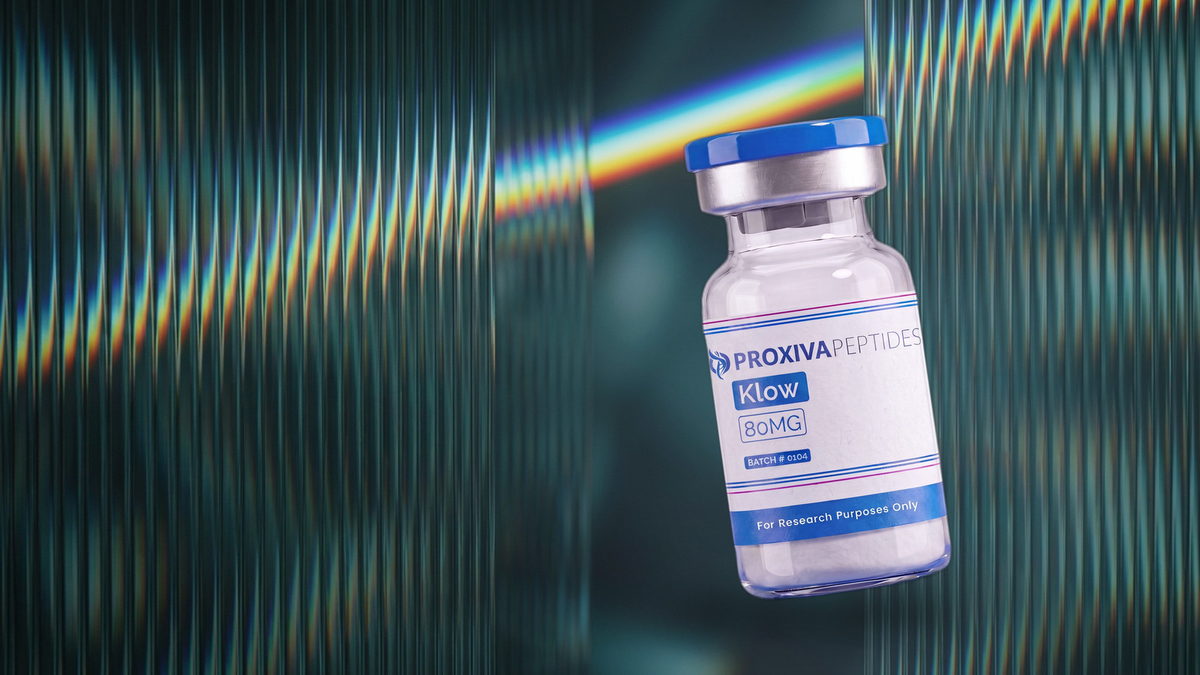
- KLOW is four peptides in one vial: GHK-Cu 50mg, TB-500 10mg, BPC-157 10mg, KPV 10mg.
- NAD+ is a single dinucleotide coenzyme — not a peptide, and consumed by the enzymes that use it.
- Per-milligram comparison is meaningless here. One number averages four compounds worth wildly different amounts; the other measures a different class of substance entirely.
- Their certificates should look nothing alike — four identities versus one chemical structure.
- A blend's combined purity figure cannot expose a weak component. That is its main verification weakness.
What each product actually is
KLOW — four peptides, one vial
Not a compound. A mixture, and every property it has is a property of its constituents:
| Component | Amount | Studied mechanism |
|---|---|---|
| GHK-Cu | 50mg | Matrix remodelling; copper-bound tripeptide |
| TB-500 | 10mg | G-actin sequestration, cell migration |
| BPC-157 | 10mg | Angiogenic signalling |
| KPV | 10mg | Inflammatory signalling |
GHK-Cu is 63% of it by mass. Whatever else KLOW is, it is mostly that one compound.
NAD+ — a coenzyme, not a drug-like molecule
Nicotinamide adenine dinucleotide is present in every cell, cycling between oxidised and reduced forms as it carries electrons through metabolism. It is also a substrate for sirtuins and PARPs, which consume it rather than merely using it catalytically — and that consumption is why availability becomes a research question at all.
So one product is four signalling peptides. The other is a working component of cellular chemistry.
Why per-milligram comparison fails here
This is the comparison people reach for and it is the least informative one available.
KLOW works out at roughly $2.38 per milligram. That figure is technically correct and analytically useless, because it averages four compounds with wildly different standalone values:
| Component | Standalone | Per mg |
|---|---|---|
| GHK-Cu 50mg | $40 | $0.80 |
| TB-500 10mg | $130 | $13.00 |
| BPC-157 10mg | $55 | $5.50 |
| KPV 10mg | $50 | $5.00 |
A sixteen-fold spread inside one product. A blend weighted toward the cheapest component will always show a favourable per-milligram figure without that reflecting anything about value.
The rule: compare blends by composition, never by total weight or cost per milligram. An 80mg blend that is 70mg of a cheap component and an 80mg blend split evenly are entirely different products at an identical headline number.
Comparing either against NAD+ per milligram compounds the error, because NAD+ is a different class of substance doing a different kind of work. There is no shared unit that makes the comparison meaningful.
What the blend does buy you
The honest case for KLOW is arithmetic, not mechanism.
Its four components bought separately come to roughly $275. KLOW lists at $190 — about 31% less. If you want all four, the blend is straightforwardly the cheaper route, and it removes three reconstitutions along with three opportunities for handling error.
It also makes sense because the four mechanisms do not overlap. Matrix remodelling, actin dynamics, angiogenic signalling and inflammatory signalling are four different levels of biology, which is why a protocol examining tissue models often wants several at once rather than choosing.
What you give up is the ratio — 50/10/10/10 is fixed at manufacture — and isolation. All four share a vial, so a substandard component compromises the whole thing with no way to separate it out.
The near-identical GLOW blend is the same base without the KPV, compared directly in GLOW versus KLOW. The single-versus-blend question is worked through in GHK-Cu versus KLOW.

Reconstitution volume: a blend constrains it
A practical consequence of multi-component vials that single-compound buyers never encounter.
With one compound, diluent volume is a free choice. Concentration is fill weight over volume, and you pick whichever suits the measurement resolution your protocol needs.
A blend removes that freedom in a subtle way. Reconstituting KLOW at any volume fixes all four concentrations simultaneously, in the 50:10:10:10 ratio the manufacturer set. Choose a volume that gives a workable GHK-Cu concentration and you have accepted whatever that produces for the three 10mg components — which are at one-fifth the concentration whether that suits them or not.
For a protocol where GHK-Cu is the compound of interest and the others are supporting, that is fine. For one where the TB-500 concentration is what matters, you are working backwards from a ratio someone else chose.
There is a second-order effect on solution life. A blend's usable window is set by its least stable component, and reconstituting more than the protocol consumes wastes all four rather than one. With separate vials you reconstitute only what you need of each. With a blend you commit the whole mixture at once.
The practical rule: reconstitute a blend in the smallest volume that keeps every component measurable, not the volume that suits the dominant one. That is a harder calculation than for a single vial, and it is worth doing before opening rather than after.
Volume arithmetic generally is covered in reconstituting research peptides.
One certificate for four things
The blend's documentation problem is structural, not a matter of supplier diligence.
A purity figure describes a sample. When the sample is four compounds, the figure describes their average — and an average cannot tell you that three components are excellent and one is not. There is no arrangement of a single number that carries that information.
This matters more for KLOW than for most blends because of the cost spread inside it. TB-500 runs about $13.00 per milligram; GHK-Cu about $0.80. A supplier economising would economise on the expensive one, and the combined figure is exactly where that would hide.
So the question to ask a blend supplier is not "what is the purity" but "is each component identified separately, and is purity reported per component?" Anything less is a number about a mixture rather than about the things in it.
GHK-Cu adds one more, and it applies whether you buy the blend or the single vial: HPLC does not detect metals. Its copper needs a separate determination. Without one, 63% of KLOW by mass is unverified no matter what the combined figure says.
NAD+ has the opposite shape of problem — one substance, one identity, but a class mismatch. It has no amino-acid sequence, so a certificate reporting one was generated from a peptide template rather than measured. That single tell should govern your reading of everything else on the page.
Field-by-field guidance in how to read a certificate of analysis.
Handling a mixture versus a single compound
A blend and a single compound fail differently, and the blend's failure mode is the one people do not plan for.
With one compound, a handling error costs you that compound. With KLOW it costs four at once, because they share a vial and cannot be separated after reconstitution. That raises the value of getting the technique right rather than relying on a margin — there is no partial loss available.
The mixture is also governed by its least stable member. You do not know which that is, so the only safe assumption is that the strictest requirement among the four applies to all of it. In practice that means genuine darkness, because KLOW is mostly GHK-Cu and copper complexes are more photosensitive than plain peptides.
NAD+ has none of these problems. It is one substance with one stability profile, and it should be stored per supplier guidance rather than by analogy to peptide practice — its chemistry is not peptide chemistry.
Technique for both is in reconstituting research peptides.
Frequently asked questions
What is in KLOW?
Four peptides in one vial: GHK-Cu 50mg, TB-500 10mg, BPC-157 10mg and KPV 10mg — 80mg total, with GHK-Cu making up 63% by mass.
Can I compare KLOW and NAD+ per milligram?
No meaningfully. KLOW's figure averages four compounds ranging from $0.80 to $13.00 per milligram, and NAD+ is a different class of substance entirely. There is no shared unit that makes the comparison informative.
Is KLOW cheaper than buying the components?
Yes — about $190 against roughly $275 separately, a saving of around 31%. That holds only if you want all four.
What is the weakness of a blend certificate?
A single combined purity figure cannot expose one weak component. Each constituent needs identifying by mass, and GHK-Cu additionally needs a copper determination that HPLC cannot provide.
Why does NAD+ get consumed?
Sirtuins and PARPs use it as a substrate rather than catalytically, so it is depleted rather than recycled — which is why availability is a research question at all.
Does KLOW need special storage?
Darkness matters more than for a typical peptide, because it is mostly GHK-Cu and copper complexes are photosensitive. Otherwise standard discipline, applied strictly since you cannot separate the components later.
Does reconstituting a blend limit my choices?
Yes. Any diluent volume fixes all four component concentrations simultaneously in the ratio the manufacturer set. Choose the volume that keeps every component measurable, not the one that suits the dominant compound.
Why does a blend waste more if I over-dilute?
Because its usable window is set by the least stable component and you commit all four at once. Separate vials let you reconstitute only what you need of each.
Which component of KLOW is most expensive?
TB-500, at roughly $13.00 per milligram standalone against GHK-Cu's $0.80 — a sixteen-fold spread inside one product, which is why the blend's averaged per-milligram figure is uninformative.
Related research compounds
- Bacteriostatic Water — $12.00
- GLP1 S — $60
- Wolverine Blend (BPC&TB500) — $95
- GLP3 R — $50
- NAD+ Full Kit (10 Vials) — 20% Off — $200
- Selank + Semax Nasal Spray — $90
- Tesa-morelin — $90
- GLP1 S Full Kit (10 Vials) — 20% Off — $240
- PT-141 Full Kit (10 Vials) — 20% Off — $240
- L - Carnitine — $55
- GLP3 - R Pen 60mg/3ml — $450
- GHK-Cu Full Kit (10 Vials) — 20% Off — $160
- AOD 9604 – 5mg — $81.00
Further reading
- 5-Amino-1MQ and NNMT Inhibition: What the Research Describes
- Research Peptides Studied in Longevity Science: Epithalon, NAD+ and SS-31
- Epithalon vs NAD+: A Research Comparison
- GHK-Cu vs Klow: A Research Comparison
- GHK-Cu vs NAD+: A Research Comparison
- MOTS-C vs Klow: A Research Comparison
- Tesa-morelin vs NAD+: A Research Comparison
Research use only. All products referenced on this page are sold strictly for laboratory and research purposes. They are not drugs, foods, cosmetics, or medical devices, and they are not intended to diagnose, treat, cure, or prevent any disease. They are not for human or veterinary consumption. Handling should be performed only by qualified individuals in an appropriate laboratory setting.