
Longevity is the area of peptide research where the gap between what is published and what is claimed is widest. Four compounds recur genuinely in the literature — epithalon, NAD+, SS-31 and 5-Amino-1MQ — and they are studied through four different mechanisms. This covers each, and is explicit about where the evidence stops.
Proxiva Handling & Storage DeskReconstitution, stability and laboratory practice
Key takeaways
- The four act on different biology: telomere-related signalling, redox coenzyme availability, mitochondrial membrane structure, and an enzyme that consumes an NAD+ precursor.
- Two of them are not peptides at all. NAD+ is a coenzyme; 5-Amino-1MQ is a small molecule. Grouping them under 'peptides' is a catalogue convention, not chemistry.
- Nearly all supporting work is cell-culture or animal-model research. Lifespan claims transferred to humans are inferences, not findings.
- Epithalon's literature is largely older and Russian-language, which makes it harder to evaluate than its confident restatement online suggests.
- Verification differs by compound class — a small molecule needs different documentation than a peptide.
What this category actually contains
"Longevity peptides" is a marketing grouping rather than a biochemical one, and the first useful step is disassembling it.
Of the four compounds that genuinely recur in this literature, only one is unambiguously a peptide. NAD+ is a dinucleotide coenzyme. 5-Amino-1MQ is a small-molecule quinolinium compound. SS-31 is a tetrapeptide, and epithalon is a tetrapeptide. So it is two peptides, one coenzyme and one small molecule, sold together because they appear in adjacent research rather than because they are chemically related.
That matters for more than pedantry. Verification requirements differ by compound class — a small molecule's certificate should reference a chemical structure, not a sequence — and so does handling. Treating the category as homogeneous is how buyers end up accepting documentation that does not describe what they received.
Epithalon — telomere-related signalling
Epithalon is a tetrapeptide: alanine-glutamate-aspartate-glycine. It was developed in Russia as a synthetic version of a peptide fraction isolated from pineal tissue.
The research interest concerns telomerase and telomere maintenance. Telomeres are repetitive sequences capping chromosome ends that shorten with successive cell divisions; telomerase is the enzyme that extends them. Work on epithalon examines effects on telomerase expression in cell culture.
Two caveats belong with any description of it. First, much of the primary literature is Russian-language and dates from the 1990s and 2000s, and English-language sources on it frequently cite one another rather than the original studies. Second, telomere biology is more contested than popular accounts suggest — telomerase activity is not a straightforward good, given its role in cell immortalisation.
Available as Epithalon 10mg and in kit form. The same evaluation problem applies here as to Semax and Selank, discussed in our Semax versus Selank comparison.
NAD+ — redox coenzyme availability
NAD+ is nicotinamide adenine dinucleotide, and it is not an exotic compound — it is a coenzyme present in every living cell, central to the redox reactions that run metabolism. It accepts and donates electrons, cycling between oxidised (NAD+) and reduced (NADH) forms.
It also serves as a substrate for several enzyme families, including sirtuins and PARPs, which consume it rather than merely using it catalytically. That consumption is what makes availability a research question rather than a given.
The longevity interest follows from that: cellular NAD+ levels decline with age in the models studied, and enzymes that depend on it are implicated in DNA repair and metabolic regulation. Whether supplementation meaningfully changes outcomes in humans is a different question from whether the decline is real.
Stocked as NAD+ and as a kit. Being a nucleotide rather than a peptide, its certificate should report on a defined chemical structure.
SS-31 — mitochondrial membrane structure
SS-31 is a tetrapeptide with an unusual property: it concentrates in the inner mitochondrial membrane, where it interacts with cardiolipin.
Cardiolipin is a phospholipid found almost exclusively in that membrane, and it is structurally important — the respiratory chain complexes depend on it to hold their proper arrangement. When cardiolipin is disrupted, respiratory efficiency falls and reactive oxygen species production rises.
The research on SS-31 concerns stabilising that interaction. This is a structural mechanism rather than a signalling one, which makes it genuinely different from the other three compounds here — it is not modulating a pathway, it is proposed to preserve an architecture.
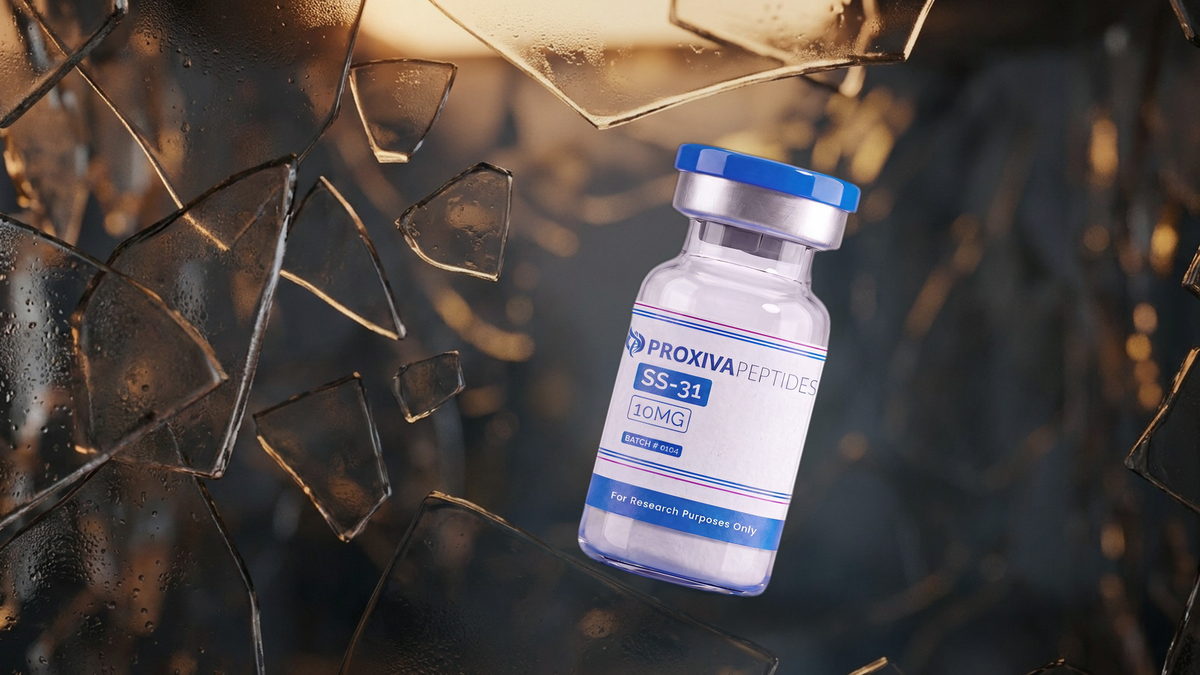
Listed as SS-31 10mg. Researchers working on mitochondrial questions commonly hold it alongside MOTS-c, which is itself mitochondrially encoded — covered in the MOTS-c sourcing guide.

5-Amino-1MQ — enzyme inhibition upstream of NAD+
The fourth is not a peptide. 5-Amino-1MQ is a small-molecule inhibitor of nicotinamide N-methyltransferase, usually shortened to NNMT.
NNMT attaches a methyl group to nicotinamide. That reaction consumes two things: the nicotinamide itself, which is an NAD+ precursor, and a molecule of S-adenosylmethionine, the universal methyl donor for a great many unrelated reactions.
So inhibiting NNMT is studied as a question about metabolic routing — less nicotinamide diverted means more available for NAD+ synthesis. That is the connection to NAD+, and it is mechanistic rather than equivalent. Supplying NAD+ directly and inhibiting an enzyme that consumes one of its precursors are different interventions.
Worth noting for anyone reading claims about it: an enzyme that consumes a shared resource has effects beyond its direct product, and selectivity across the methyltransferase family is an empirical question rather than something the compound's name settles. Covered in the 5-Amino-1MQ guide. Stocked as 5-Amino-1MQ 10mg.
Where the evidence stops
This section is the one most articles on this topic omit, and it is the most important.
Every mechanism described above is documented in cell-culture or animal-model research. Those are real findings about real biology. What none of them establish is that any of these compounds extends life or slows ageing in humans.
The gap is structural, not incidental. Human lifespan studies would take decades, and the intermediate markers researchers use as proxies — telomere length, NAD+ concentration, mitochondrial function — are markers, not outcomes. A compound that moves a marker has moved a marker.
Model organism results add another layer. Lifespan extension in short-lived organisms is a genuine finding in that organism and a weak predictor for long-lived ones, because the constraints on lifespan differ between them.
None of this makes the compounds uninteresting. It makes specific claims about them unsupportable, and it means a supplier making those claims is telling you something about its documentation rather than about the compound.
Reading longevity claims generally
A filter that works across this whole category, and that removes most of what circulates about it.
Ask which organism. A lifespan result in a nematode, a fly and a mouse are three different claims of decreasing distance from anything human. Popular write-ups routinely drop the organism, which is the single most informative word in the sentence.
Separate marker from outcome. Telomere length, NAD+ concentration and mitochondrial respiration rate are measurable and meaningful, but they are proxies chosen because the real endpoint takes decades. Moving a proxy is a finding about the proxy.
Check the direction of the inference. That a quantity declines with age does not establish that restoring it reverses anything. Decline may be consequence rather than cause, and much of the confident writing in this space quietly assumes the harder direction.
Notice unusual precision. Specific percentages for lifespan extension imply quantitative studies in a named model. Where the underlying literature is thin, precision is a warning rather than a reassurance — the same discipline that applies to the Russian-language literature behind epithalon.
Applied consistently this leaves a smaller and better-supported set of claims: these compounds have documented mechanisms, those mechanisms are plausibly relevant to ageing biology, and what follows from that in humans is not established. That is a less satisfying summary than most articles offer, and it is the one the evidence supports.
Sourcing and verification across the four
Because the four span three compound classes, the documentation you should expect differs.
| Compound | Class | Identity test to insist on |
|---|---|---|
| Epithalon | Tetrapeptide | Mass spec against theoretical mass |
| SS-31 | Tetrapeptide | Mass spec; note non-standard residues |
| NAD+ | Dinucleotide coenzyme | Structure-based; not a sequence |
| 5-Amino-1MQ | Small molecule | Mass spec or ideally NMR; salt form stated |
A recurring tell across this category: certificates generated from a peptide template applied to non-peptides. If a certificate for NAD+ or 5-Amino-1MQ reports a "sequence," it was produced from a form rather than from analysis, and nothing else on it should be trusted either.
Otherwise the standard applies throughout — HPLC purity with the chromatogram, batch number matching the vial, a named independent testing laboratory, and a residual solvent panel. Detail in how to read a certificate of analysis and choosing a supplier.
Handling is ordinary discipline: lyophilised material cold, dry and dark; bacteriostatic water for multi-draw reconstitution; diluent down the vial wall; swirl rather than shake; refrigerate, label, never re-freeze. Full procedure in reconstituting research peptides.
Broader panels in this area commonly add Glutathione, L-Carnitine, GHK-Cu, BPC-157, TB-500, Semax, Selank, DSIP and Ipamorelin.
Frequently asked questions
Which peptide is best for longevity?
The four compounds that recur in this literature act through unrelated mechanisms — telomere-related signalling, redox coenzyme availability, mitochondrial membrane structure and enzyme inhibition — so they are not ranked alternatives to one another.
Are these all actually peptides?
No. Epithalon and SS-31 are tetrapeptides. NAD+ is a dinucleotide coenzyme and 5-Amino-1MQ is a small molecule. They are grouped by research context, not chemistry.
How strong is the evidence for lifespan extension?
In humans, absent. The published work is cell-culture and animal-model research measuring intermediate markers such as telomere length or NAD+ concentration — markers, not outcomes.
Why is epithalon's research harder to evaluate?
Much of the primary literature is Russian-language and dates from the 1990s and 2000s, and English secondary sources frequently cite each other rather than the original studies.
How does 5-Amino-1MQ relate to NAD+?
NNMT consumes nicotinamide, an NAD+ precursor. Inhibiting the enzyme is studied as a question about reducing that competition — a mechanistic relationship, not an equivalent intervention.
Does a certificate differ for non-peptides?
Yes. A small molecule or coenzyme certificate should reference a chemical structure and state salt form, not report a sequence. A certificate reporting a sequence for NAD+ was produced from a template.
Related research compounds
Further reading
- 5-Amino-1MQ and NNMT Inhibition: What the Research Describes
- Epithalon vs NAD+: A Research Comparison
- Epithalon vs SS31: A Research Comparison
- GHK-Cu vs NAD+: A Research Comparison
- Peptide Storage and Stability: Lyophilized vs Reconstituted
- Where to Buy Epithalon: Claims, Evidence and Verification
- Where to Buy MOTS-c: Sourcing, Purity and Handling
Research use only. All products referenced on this page are sold strictly for laboratory and research purposes. They are not drugs, foods, cosmetics, or medical devices, and they are not intended to diagnose, treat, cure, or prevent any disease. They are not for human or veterinary consumption. Handling should be performed only by qualified individuals in an appropriate laboratory setting.