
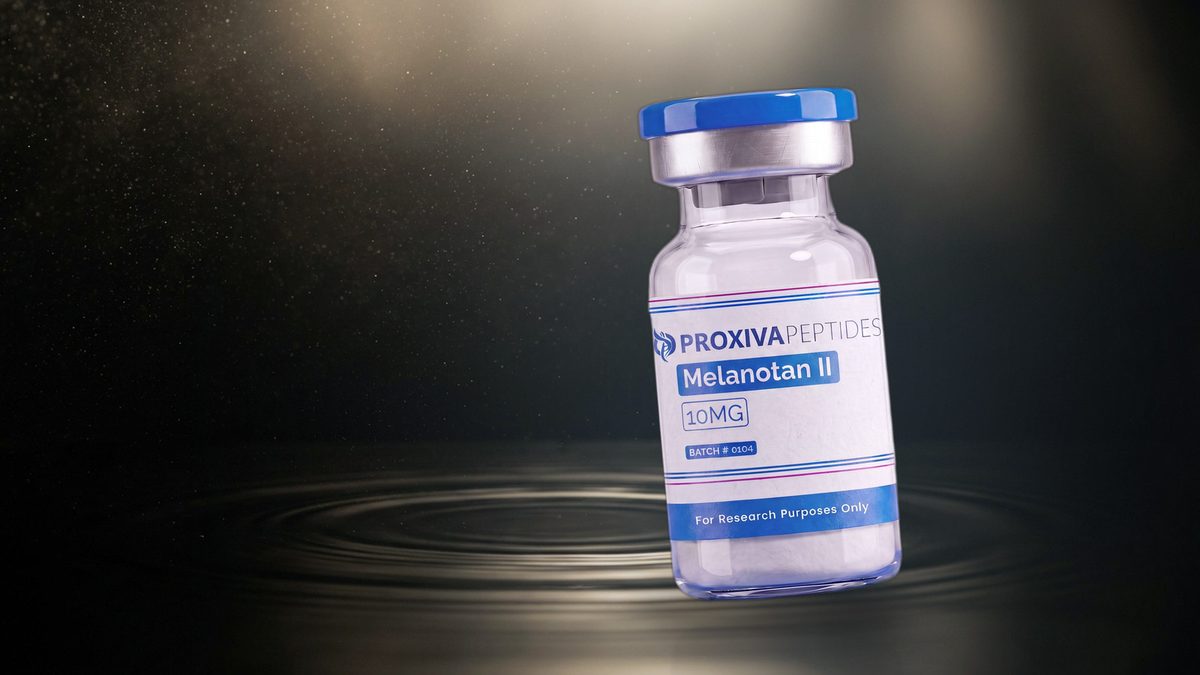
Melanotan II differs from most of this catalogue in two ways that matter before you buy: it is cyclic, which changes how it fails, and its receptor family is spread across many tissues, which changes how broadly it acts.
Proxiva Comparative ReviewCompound-versus-compound analysis
Key takeaways
- Broadest engagement of the three options here — the receptor family spans several tissue types and this molecule discriminates poorly between them.
- A linear peptide fails by dropping a residue — a cyclic one fails by never closing its ring.
- Mass spectrometry catches the first cleanly — only chromatographic separation catches the second.
- Price is effectively identical across the three — $50 here and for MT-1 against $60 for PT-141 — which makes cost the least useful basis for choosing.
- Structural facts are secure — outcome claims are not — and the distance between those positions is unusually wide for this compound.
The short answer, against the alternatives
Three options sit close on price — and far apart on what they suit. That makes price the least informative comparison available.
| Melanotan II | PT-141 | MT-1 | |
|---|---|---|---|
| Fill | 10mg | 10mg | 10mg |
| Price | $50 | $60 | $50 |
| Per mg | $5.00 | $6.00 | $5.00 |
| Structure | Cyclic | Cyclic | Linear |
| Target breadth | Broad | Narrower | Narrower |
| Key check | Cyclisation | Cyclisation | Standard |
Narrow question — wrong instrument. Whatever gets observed will admit several explanations, and nothing in the observation itself separates them.
Family-level question — right instrument. That same breadth is the property being relied upon rather than a limitation, and a narrower compound cannot reach the answer at all.
The ten-dollar spread is immaterial next to that distinction. Choosing on price between instruments built to answer different questions means choosing on the one dimension carrying no information.
Why the target distribution decides so much
This is where the compound parts company with most of the catalogue.
A single receptor is a location. A receptor family is not — it is several subtypes, sitting in different tissues, doing different jobs. That distinction is the whole matter.
Engage the family and you engage whichever subtypes the molecule binds, wherever they happen to be. Whether it favours some over others is called selectivity — and selectivity is a property a molecule either has or lacks. Intent does not supply it.
This compound is not notably selective. So the profile spans more than one system — not as an anomaly, but as a direct consequence of what it is.
Compare the alternatives on that basis rather than on price. PT-141 engages more narrowly; MT-1 likewise. Narrow suits a narrow question. Broad suits a broad one.
The general rule transfers well beyond these three: before asking what a compound does, ask where its target sits. A target confined to one tissue constrains the effects. A scattered one does not.

Two vials, same label, different molecules
There is a consequence of cyclisation that catches careful buyers — and generic peptide guidance does not cover it.
Cyclisation is a discrete step. It either completed or it did not — and how far it completed varies between production runs. So two vials can carry the same label and the same stated purity while holding quite different proportions of closed and open material.
Neither supplier need have behaved dishonestly. The certificate accompanying each vial may simply never have posed the question that would have exposed the difference.
The mechanism is straightforward. Purity gets assessed relative to everything else present — and because the open form consists of the same atoms as the closed one, a method that separates the two poorly reports both together as product.
What results is a high purity figure describing a mixture of two forms — only one of which is what was ordered. Nothing on the face of the document indicates anything went wrong.
Contrast the linear case. There the characteristic impurity is a shortened chain carrying a plainly different mass — flagged immediately by any competent analysis.
Hence the narrow and specific request to make of a supplier: not the purity percentage, not the mass result alone — the chromatographic trace. Everything else can look entirely correct while the question that matters goes unasked.
Cyclisation, and the check most people skip
The verification differences here are specific and they are not covered by generic peptide advice.
This is a cyclic peptide, meaning the chain is joined to form a ring. Cyclisation is a distinct manufacturing step and it is the step that most often goes incomplete, leaving residual open-chain material in the product.
Here is why that matters more than it sounds. Forming the ring changes the molecule's mass by a very small amount — so the cyclised product and its uncyclised precursor sit close together, and a mass spectrometry result alone may not separate them cleanly.
What resolves them is chromatographic separation. So for this compound specifically, a certificate reporting mass confirmation without a legible trace has left the characteristic defect of the compound class unexamined. Ask for the chromatogram, and treat a refusal as informative.
Contrast that with a linear peptide of similar length such as Selank or KPV, where the dominant risk is a wrong molecule or a light fill and the trace matters less. The right verification is the one matched to how the specific molecule fails, and that differs by structure.
Neither this compound nor its cyclic neighbours has a widely circulated reference standard, which places more weight on whoever performed the analysis. An independent laboratory report is worth materially more here than one from the synthesis facility.
What a broad target profile costs an experiment
Set against the narrower alternatives, the practical cost of breadth is attribution, and it is worth spelling out because it decides whether a result will mean anything.
With a narrowly targeted compound, an observed change has a small number of candidate causes. With a broadly targeted one, the same observation has many, and nothing about the observation itself distinguishes them.
That is not an argument against breadth. If the question genuinely concerns the receptor family as a whole, a narrow compound cannot answer it and the broad one is correct. The error is using a broad compound to ask a narrow question and then reading the result as though it were specific.
How do you tell which you have? Ask what would count as a negative result. If almost any outcome could be explained by the compound acting somewhere, the design cannot fail, and a design that cannot fail cannot inform.
Compared with PT-141 at $60, the $10 saving on this vial is immaterial next to that distinction. Format and targeting decide the experiment; price decides almost nothing.
The same reasoning applies wherever a catalogue offers several compounds against one system. Choosing on price between instruments that answer different questions is choosing on the only dimension that does not matter.
The regulatory position, which comes first
For this compound the legal question is more clearly answerable than the pharmacological one and should be settled before it.
Material of this kind is supplied for laboratory research. That describes what it may lawfully be used for; it is not a formality that stops applying if a buyer reads it as packaging copy.
Numerous jurisdictions define a prescription drug by reference to what a substance is rather than to how a seller has described it or what a purchaser intended. An unapproved injectable peptide can meet that definition on its own terms, and where it does, the purpose behind a transaction determines its lawfulness.
This applies to every item in this comparison and across the category generally. It is worth resolving first because, unlike questions about mechanism or verification, its answer does not depend on whether the compound does anything at all.
Handling
Dry and refrigerated, it is stable for extended periods. Reconstituted, it is not, and cold storage stops being optional at that point.
Use bacteriostatic water where the vial will be entered more than once. Introduce it down the wall of the glass rather than onto the powder, and let dissolution proceed rather than forcing it by agitation.
Avoid repeated warming and cooling. Cycling a vial in and out of the cold does more cumulative damage than a single heavy-handed reconstitution, and it is the harder failure to notice because no individual instance looks like a mistake.
At a 10mg fill, what remains on the glass and stopper is a meaningful proportion of what was purchased, so recover deliberately rather than quickly.
What is not established
The compound has a literature, and it is smaller and older than the confident tone of most writing about it suggests.
Nothing published examines it in combination with anything else in this catalogue. Combination claims are therefore extrapolation with no supporting study, and additive reasoning about compounds is least reliable precisely where individual behaviour is least well bounded — which, given the target distribution described above, is the situation here.
The honest summary is that the structural facts are solid, the receptor distribution is well characterised, and claims about outcomes rest on considerably less than the certainty with which they are usually stated.
One last practical point, easily missed. Because no reference standard for this compound circulates widely, two certificates from two laboratories are not automatically comparable — each rests on that laboratory's own calibration. Where a result matters, the laboratory identity is part of the result, not metadata attached to it.
Frequently asked questions
How does it compare with PT-141 and MT-1?
All three carry a 10mg fill — $50 here and for MT-1 against $60 for PT-141 — so the real distinction is breadth rather than cost. This compound addresses the receptor family widely; the alternatives address it narrowly.
Why does verification differ from a linear peptide?
The characteristic failure differs in kind — not degree. A linear chain omits a residue and produces a plainly different mass. A cyclic one stays open and produces something nearly indistinguishable by mass.
What must the certificate contain?
A batch match and identity confirmation — but critically the chromatographic trace itself rather than a summary figure. Separation by retention time rather than by mass is what distinguishes closed from open material.
Why are the effects described as broad?
Because the receptor subtypes sit across different tissues with distinct physiology — so breadth follows from target distribution rather than from any deficiency in the molecule.
Is the compound approved for any use?
No — investigational research material only. Many jurisdictions define prescription status by what a substance is rather than how it has been described, which makes intended use the operative question.
Can it be combined with other compounds?
No combination evidence exists — and additive reasoning fails hardest where individual behaviour is least bounded, which given this target distribution describes the position exactly.
Related research compounds
- SS31 – 10mg — $80
- Semax – 10mg — $50
- Klow – 80mg — $190
- Glow – 70mg — $174.00
- CJC-1295 No DAC — $62
- AOD 9604 – 5mg — $81.00
- L - Carnitine — $55
- Slupp — $200
- GLP2 T — $70
- Tesa-morelin — $90
- Wolverine Blend (BPC&TB500) — $95
- Ipamorelin — $40
- GHK-Cu (Copper Peptide) — $40
- BPC-157 — $36.00
Further reading
- How to Read a Peptide Certificate of Analysis: HPLC, Mass Spec and Red Flags
- Melanotan II: Verifying Purity and Reading the COA Before You Buy
- GLP3 R vs Melanotan II (MT-II): A Research Comparison
- TB-500, Actin Polymerisation and Cell Migration: The Mechanism
- Where to Buy Thymosin Beta-4 (TB-500): Purity, COA and Sourcing
Research use only. All products referenced on this page are sold strictly for laboratory and research purposes. They are not drugs, foods, cosmetics, or medical devices, and they are not intended to diagnose, treat, cure, or prevent any disease. They are not for human or veterinary consumption. Handling should be performed only by qualified individuals in an appropriate laboratory setting.