
Melanotan II is among the most widely counterfeited research peptides sold online, and much of the material circulating through general marketplaces carries documentation that does not survive inspection. This guide covers what the compound is, how to verify a certificate of analysis for it, and why marketplace sourcing carries particular risk here.
Proxiva Analytical DeskCertificate review, purity and identity testing
Key takeaways
- Melanotan II is a synthetic cyclic heptapeptide analogue of alpha-MSH, studied as a non-selective melanocortin receptor agonist.
- It is frequently confused with Melanotan I and with PT-141 (bremelanotide), which is a structurally related but distinct compound.
- Because the three are related, mass-spectrometry identity confirmation matters more here than for most peptides — HPLC purity alone will not distinguish them.
- General marketplaces are a high-risk channel: listings routinely reuse a single COA image across unrelated sellers and batches.
- Verify the batch number on the certificate against the vial label before anything else. It is the field that ties document to material.
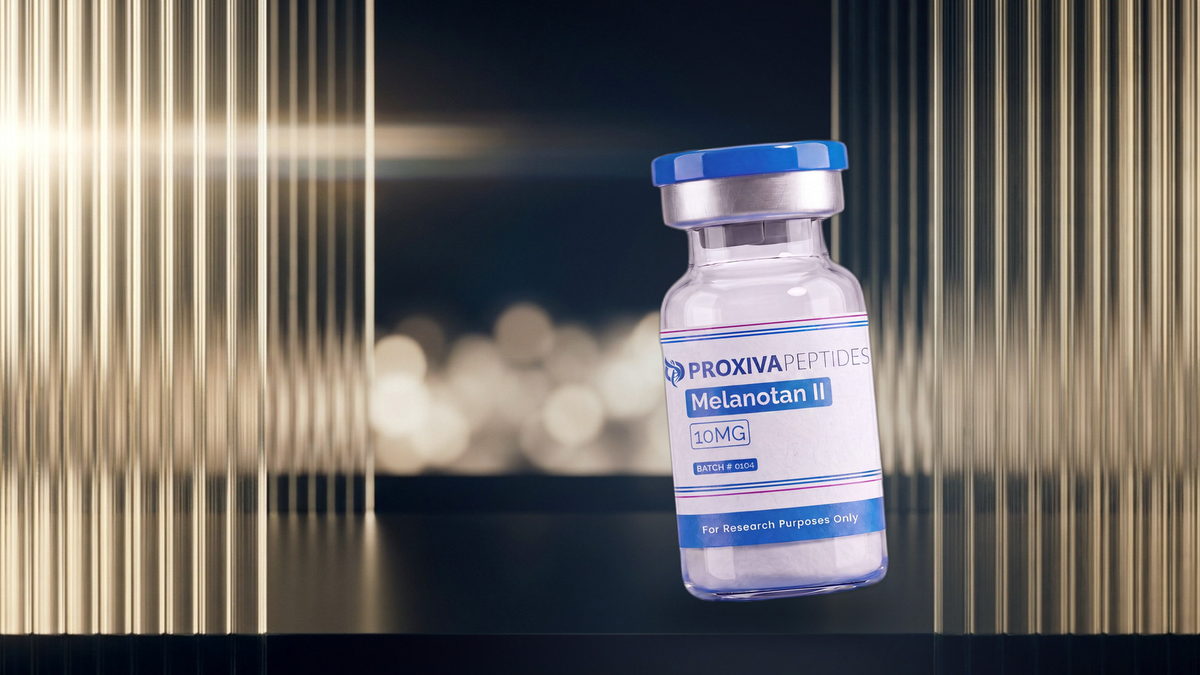
What Melanotan II is
Melanotan II is a synthetic cyclic heptapeptide — seven amino acids arranged in a ring structure — developed as an analogue of alpha-melanocyte-stimulating hormone (alpha-MSH). The cyclisation is chemically significant: it constrains the molecule's shape and gives it considerably greater stability than the linear native hormone, which degrades rapidly.
In research contexts it is characterised as a non-selective melanocortin receptor agonist, meaning it binds across several receptor subtypes rather than targeting one. That non-selectivity is the defining pharmacological property distinguishing it from more targeted analogues in the same family.
The compound appears in catalogues as Melanotan II, commonly at 10mg fill weight, and in pre-filled format as a 50mg pen.
The identity problem: three related compounds
More than most peptides, Melanotan II sits in a cluster of closely related molecules that are routinely conflated in listings:
| Compound | Structure | Distinguishing feature |
|---|---|---|
| Melanotan I (afamelanotide) | Linear analogue of alpha-MSH | Selective for the MC1 receptor subtype |
| Melanotan II | Cyclic heptapeptide | Non-selective across melanocortin receptors |
| PT-141 (bremelanotide) | Metabolite of Melanotan II | Differs by the removal of a terminal group |
PT-141 is the case most likely to cause confusion, because it is literally a metabolite of Melanotan II — the two differ by a single structural change at one end of the molecule. They have different molecular weights, but an HPLC trace of either looks like a clean single peak. Purity testing cannot tell them apart.
This is why mass spectrometry is not optional for this compound family. It is the only routine test that establishes which of Melanotan I, Melanotan II or PT-141 is actually in the vial.
Why marketplace sourcing is higher risk here
Melanotan II is one of the compounds most commonly encountered on general trading platforms rather than research-supply channels, and the documentation practices there are markedly worse.
The recurring pattern is a single certificate image reused across many listings. The same JPEG appears under different seller names, for different batches, sometimes for different compounds entirely. Because it is an image rather than a document tied to a batch record, nothing about it can be verified — and it costs a seller nothing to attach.
- The same COA image appearing across multiple unrelated sellers
- No batch number, or one that appears on every listing from that seller
- A certificate with the testing laboratory's name cropped out or illegible
- Purity claims with no chromatogram trace attached
- Listings that use Melanotan I, Melanotan II and PT-141 interchangeably in the same description
None of this means marketplace material is necessarily counterfeit. It means the documentation provides no evidence either way, which for research purposes amounts to the same thing.
Verifying a Melanotan II certificate
The check is the same as for any peptide, with additional weight on identity:
- Batch number matches the vial label. First check, every time.
- Mass-spectrometry result present. For this compound family specifically, this is what separates the three related molecules.
- HPLC purity at 98% or above, with the chromatogram image included rather than a bare figure.
- Testing laboratory named, and ideally independent of the synthesising facility.
- Residual-solvent panel present, covering TFA, acetonitrile and DMF.
- Test date shown. An undated certificate cannot be tied to anything.
The full procedure, including what each field on a certificate means, is covered in our guide to reading a peptide certificate of analysis.

Handling and storage
The cyclic structure gives Melanotan II better stability than linear peptides of comparable size, but standard handling discipline still applies.
Lyophilised powder should be kept cold, dry and out of light in its sealed vial. Reconstitution with bacteriostatic water is standard for any vial that will be punctured more than once, since the benzyl alcohol content suppresses microbial growth across repeated draws.
- Add diluent slowly against the vial wall, never directly onto the powder cake
- Swirl gently to dissolve — shaking shears peptide chains
- Refrigerate after reconstitution and record the date on the vial
- Never re-freeze reconstituted solution; freeze-thaw cycling degrades integrity measurably
- Keep protected from light throughout
Storage practice is covered in more depth in our guide to peptide storage and stability.
Comparing suppliers
Price per milligram is the only fair comparison, and fill weights vary enough across this compound family that headline vial prices routinely mislead. A 10mg vial and a 5mg vial at similar prices differ by a factor of two in the cost of material.
Beyond price, the differentiators worth weighing are whether certificates are published without being requested, whether they are batch-specific, whether an independent laboratory is named, and how long material spends in transit. Heat exposure during shipping degrades peptides, and a lower price does not recover that.
Researchers working across this receptor family commonly stock several related compounds together — Melanotan II alongside Melanotan I and PT-141 — precisely because the comparisons are the point of the work. Broader panels often include unrelated material such as BPC-157, Ipamorelin, Epithalon or GHK-Cu depending on the protocol.
Why cyclic structure changes the handling calculus
Melanotan II's ring structure is not merely a chemical curiosity — it has direct practical consequences worth understanding.
Linear peptides are vulnerable to exopeptidases, enzymes that cleave residues from the ends of a chain. A cyclic peptide has no free ends to attack, which removes that entire degradation route. The constrained conformation also resists the shape changes that precede aggregation.
The result is a compound noticeably more robust than a linear peptide of equivalent length. Native alpha-MSH, the linear parent, degrades rapidly; the cyclic analogue does not.
This does not license careless handling. Hydrolysis of internal bonds still occurs in solution, oxidation still affects vulnerable residues, and heat exposure remains cumulative and irreversible. What the ring buys is a wider margin for error, not exemption from the rules.
The practical implication for buyers is that visible degradation is a poor screening tool here. A cyclic peptide that has been mishandled may look entirely normal, because the failure modes that produce visible changes are the ones its structure resists. Documentation, not appearance, is the check that works.
What the impurity profile can tell you
Beyond the headline purity figure, the shape of what remains is informative about how the material was made.
Synthesis of a cyclic peptide involves an extra step — the cyclisation itself — and incomplete cyclisation leaves linear precursor behind. That precursor is a different molecule with a different molecular weight, and on a chromatogram it appears as a distinct peak rather than as generic impurity.
A certificate reporting high purity with a single notable secondary peak is describing a different situation from one reporting the same purity spread across many small peaks. The first suggests one identifiable side product from a specific step; the second suggests a less controlled process overall.
This is why the chromatogram matters more than the percentage for cyclic compounds specifically. The number treats all impurity as equivalent; the trace does not.
Where a supplier publishes only a figure, the question worth asking is whether linear precursor was quantified separately. A facility that understands its own process will have an answer.
Frequently asked questions
Is Melanotan II the same as PT-141?
No. PT-141 (bremelanotide) is a metabolite of Melanotan II, differing by a structural change at one end of the molecule. They have different molecular weights, but HPLC purity testing cannot distinguish them — only mass spectrometry can.
What is the difference between Melanotan I and Melanotan II?
Melanotan I is a linear analogue selective for the MC1 receptor subtype. Melanotan II is a cyclic heptapeptide that acts non-selectively across melanocortin receptors.
Why is mass spectrometry especially important for this compound?
Because Melanotan I, Melanotan II and PT-141 are closely related. An HPLC trace of any of them looks like a clean single peak, so purity testing alone cannot establish which molecule is in the vial.
Why is marketplace-sourced Melanotan II considered higher risk?
Because certificate images are routinely reused across unrelated sellers and batches. An image not tied to a batch record cannot be verified, so it provides no evidence about the material received.
How should Melanotan II be stored?
Lyophilised powder cold, dry and dark in the sealed vial. After reconstitution with bacteriostatic water, refrigerate, record the date, and do not re-freeze.
Related research compounds
- AOD-9604 Full Kit (10 Vials) — 20% Off — $324
- Glutathione – 1500mg — $70
- AOD 9604 – 5mg — $81.00
- BPC-157 Full Kit (10 Vials) — 20% Off — $144.00
- Glutathione Full Kit (10 Vials) — 20% Off — $280
- PT-141 Full Kit (10 Vials) — 20% Off — $240
- Tesa-morelin Full Kit (10 Vials) — 20% Off — $360
- GLP3 R — $50
- GHK-Cu Pen 300mg/3ml — $300
- DSIP Full Kit (10 Vials) — 20% Off — $256
- L - Carnitine — $55
Further reading
Research use only. All products referenced on this page are sold strictly for laboratory and research purposes. They are not drugs, foods, cosmetics, or medical devices, and they are not intended to diagnose, treat, cure, or prevent any disease. They are not for human or veterinary consumption. Handling should be performed only by qualified individuals in an appropriate laboratory setting.