
Peptide Calculator
Accurately calculate reconstitution dosages for your research peptides. Select your peptide, set your parameters, and get precise syringe measurements instantly.
This calculator is provided for research and educational purposes only. It is not intended as medical advice. All peptide products are sold strictly for laboratory research use. Always verify calculations independently before use in any research protocol.
How It Works
Three simple steps to calculate your reconstitution dosage
Select Your Peptide
Choose from our catalog to auto-fill recommended parameters, or enter custom values manually.
Set Parameters
Adjust vial size, bacteriostatic water volume, desired dose, and syringe type to match your setup.
Read Your Results
Instantly see how many units to draw, the solution concentration, and how many doses your vial contains.
Peptide Reconstitution Guide
Step-by-step instructions for reconstituting lyophilized peptides
Ensure you are working in a clean, sanitized area. Gather all necessary supplies before beginning:
- Lyophilized peptide vial
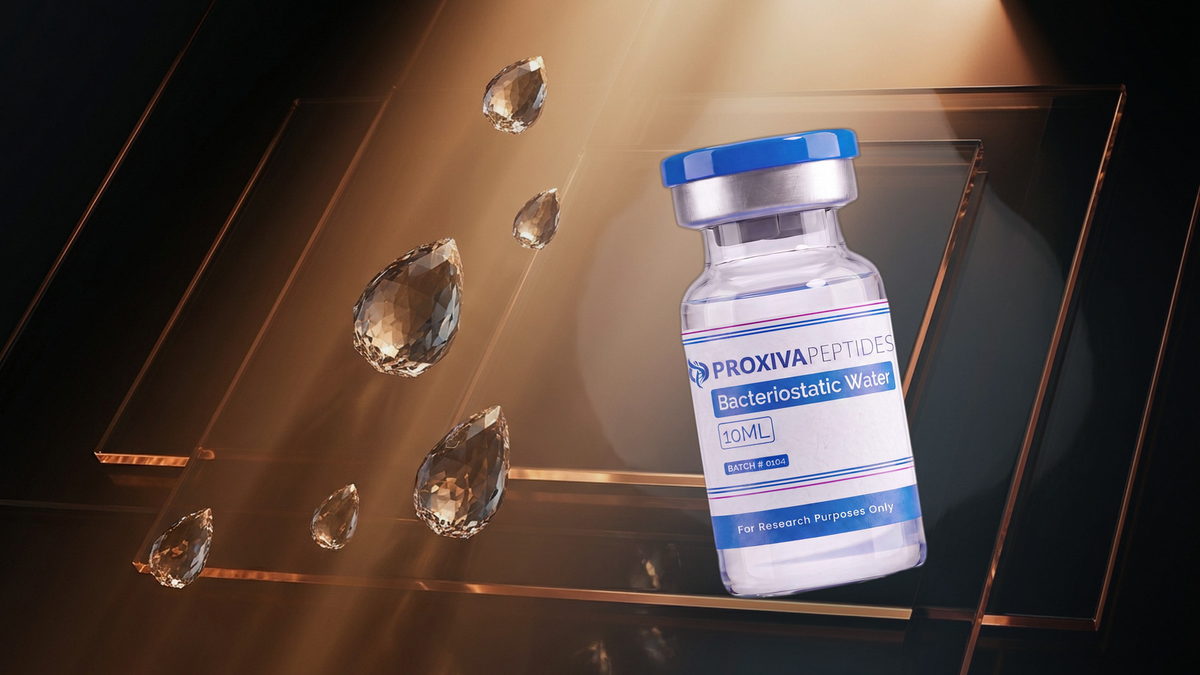
- Bacteriostatic water (BAC water with 0.9% benzyl alcohol)
- Sterile insulin syringe (0.3mL, 0.5mL, or 1.0mL)
- Alcohol swabs for disinfection
- Clean gloves
Allow both the peptide vial and bacteriostatic water to reach room temperature before reconstitution. This prevents thermal shock to the peptide structure.
- Remove the plastic cap from the peptide vial to expose the rubber stopper
- Wipe the stopper with an alcohol swab and allow to air dry
- Do the same for the bacteriostatic water vial
Using your sterile syringe, draw the desired amount of bacteriostatic water (use our calculator above to determine the right amount).
- Insert the needle into the peptide vial at a slight angle
- Slowly dispense the water down the inner wall of the vial — do not spray directly onto the powder
- Gently swirl the vial until the peptide is fully dissolved — never shake vigorously
- The solution should be clear. If cloudy, allow more time to dissolve
- Unreconstituted (powder): Store at 2–8°C for short-term, or -20°C for long-term storage
- Reconstituted (solution): Refrigerate at 2–8°C and use within 28 days for optimal stability
- Avoid repeated freeze-thaw cycles
- Protect from direct light exposure
- Always use a new sterile syringe for each withdrawal from the vial
How this calculator compares to the others
Several peptide calculators are in common use and researchers often arrive here having tried one of them. Most are built around the same arithmetic — total peptide mass divided by diluent volume — so the differences are in what they do with the result rather than in the mathematics.
Supplier-hosted calculators such as the Bachem and Biosynth tools are built for synthesis and analytical work, and are oriented toward molecular weight, sequence composition and extinction coefficients rather than toward reconstitution volume. The Cellgenic calculator and the various vendor-hosted reconstitution tools sit closer to what most researchers actually need, which is concentration and volume per syringe graduation.
What this one adds is the per-unit conversion done explicitly. Getting concentration right and then misreading a graduated syringe is the most common arithmetic error in practice, and it happens after every calculator has finished its job. This tool carries the calculation through to the mark on the barrel, requires no sign-up, and stores nothing.
It is also worth saying plainly what no calculator can do: none of them verifies that the vial contains what the label says. The fill weight you type in is an assumption, and it is only as good as the certificate behind it. Every batch sold here publishes its certificate on the test results page, and the reconstitution arithmetic is downstream of that.
Frequently Asked Questions
Common questions about peptide reconstitution and dosage calculation
Reconstitution is the process of dissolving a lyophilized (freeze-dried) peptide powder with a sterile solvent, typically bacteriostatic water. This creates an injectable solution at a known concentration, allowing precise dosage measurement using an insulin syringe.
The amount depends on your desired concentration and dose. Common guidelines:
- Standard peptides (5–10mg vials): 1–3 mL of BAC water
- GLP-1 peptides (GLP-1 S, GLP-2 T): 1–2 mL for higher concentration
- Large vials (50mg+): 2–5 mL
More water = lower concentration = easier to measure small doses. Less water = higher concentration = fewer injections per vial. Use our calculator to find the optimal amount.
Insulin syringes are marked in “units.” A standard U-100 insulin syringe has 100 units per 1 mL:
- 1.0 mL syringe: 100 units total, marks every 2 units
- 0.5 mL syringe: 50 units total, marks every 1 unit
- 0.3 mL syringe: 30 units total, marks every 1 unit (best for small doses)
To convert: Units = mL × 100. So 0.25 mL = 25 units, and 0.05 mL = 5 units.
When stored properly at 2–8°C (standard refrigerator), most reconstituted peptides remain stable for approximately 28 days. The benzyl alcohol preservative in bacteriostatic water helps prevent microbial growth. For longer storage, some peptides can be frozen at -20°C for up to 3–4 months, though repeated freeze-thaw cycles should be avoided.
1 mg = 1,000 mcg (micrograms). Common conversions:
- 0.1 mg = 100 mcg
- 0.25 mg = 250 mcg
- 0.5 mg = 500 mcg
- 1 mg = 1,000 mcg
- 2.5 mg = 2,500 mcg
- 5 mg = 5,000 mcg
- 0.3 mL (30 units): Best for micro-dosing and very small volumes. Each mark represents 0.5–1 unit, giving maximum precision.
- 0.5 mL (50 units): The most common choice. Good balance of precision and capacity for most peptide doses.
- 1.0 mL (100 units): Best for larger volume injections. Useful for higher-dose peptides or when using less BAC water.
Choose the smallest syringe that comfortably holds your dose for the most accurate measurement.
The calculator uses standard reconstitution formulas:
- Concentration = Vial Size (mg) ÷ BAC Water (mL) = mg/mL
- Volume to Inject = Desired Dose (mg) ÷ Concentration (mg/mL) = mL
- Syringe Units = Volume (mL) × 100 = units (on a U-100 syringe)
- Doses Per Vial = Vial Size (mg) ÷ Dose Per Injection (mg)
Example: A 5mg vial reconstituted with 2mL BAC water gives a concentration of 2.5 mg/mL. For a 250 mcg (0.25 mg) dose: 0.25 ÷ 2.5 = 0.1 mL = 10 units on the syringe. The vial contains 5 ÷ 0.25 = 20 doses.
Yes. This calculator uses the same standard reconstitution formulas used in pharmaceutical compounding. The math is straightforward unit conversion. However, always double-check your calculations before use in any research protocol, and ensure your measuring instruments (syringes) are properly calibrated and appropriate for the volume being measured.
Ready to Start Your Research?
Browse our full catalog of research-grade peptides with certificates of analysis.
Shop Peptides →