
Three residues against a fragment of a 43-residue protein. Length drives everything below: price, purification difficulty, and which of the two can be sold as something it is not.
Proxiva Analytical DeskCertificate review, purity and identity testing
Key takeaways
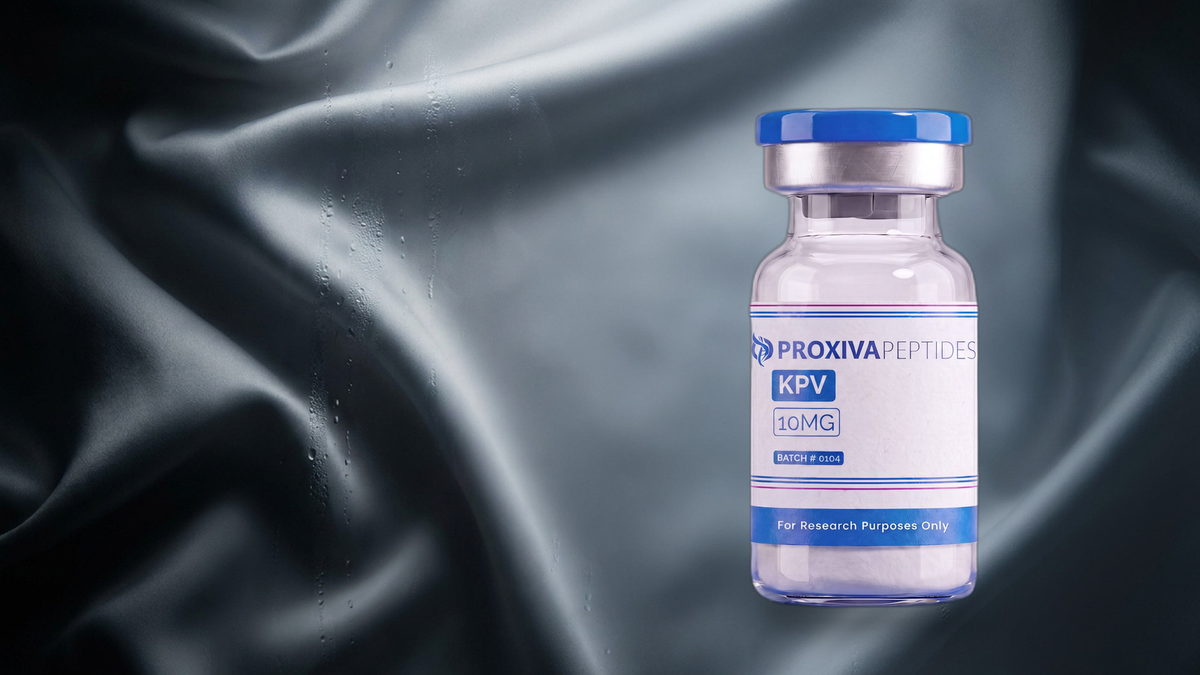
- KPV is three residues — the C-terminal fragment of alpha-MSH.
- TB-500 as sold is usually a synthetic fragment of Thymosin Beta-4, a 43-residue protein — not the full protein, despite frequent labelling to the contrary.
- Length drives cost: KPV $5.00/mg, TB-500 $13.00/mg. Synthesis yield compounds across every coupling step.
- TB-500 carries a specific identity risk the shorter peptide does not — fragment sold as full protein, distinguishable only by mass.
- Both appear together in KLOW alongside GHK-Cu and BPC-157.
The reject list, before anything else
Stop on any of these. For TB-500 the first item is the one that matters most.
- No mass-spectrometry result on TB-500. Fatal. The fragment and the full 43-residue protein have different molecular weights and are routinely sold interchangeably. Purity cannot tell them apart.
- The listing uses "TB-500" and "Thymosin Beta-4" as synonyms without stating which you receive. They are not synonyms.
- Lot number missing or not matching the vial. The certificate describes other material.
- Purity figure with no chromatogram. For a longer peptide the trace shows deletion sequences the percentage averages away.
- Testing laboratory unnamed, or the synthesising facility certifying its own output with no independent check.
- No residual-solvent panel. TFA, acetonitrile and DMF are inevitable products of solid-phase synthesis.
KPV is a lower-risk purchase on every one of these axes, for a structural reason covered below.
At a glance
| KPV | TB-500 | |
|---|---|---|
| Sequence | Lys–Pro–Val | Fragment of a 43-residue protein |
| Complete molecule? | Yes | No — a fragment |
| Parent | alpha-MSH | Thymosin Beta-4 |
| Confusable with parent? | No | Yes, routinely |
| Studied mechanism | Inflammatory signalling | G-actin sequestration |
| Fill · price | 10mg · $50 | 10mg · $130 |
| Per mg | $5.00 | $13.00 |
| Crude synthesis yield | ~97% | Substantially lower |
| Dominant impurity | Minimal | Deletion sequences |
| Mass spec | Confirmatory | Decisive |
Three rows carry the whole comparison: complete versus fragment, confusable versus not, and the 2.6× price gap that follows from chain length.
Length → cost
One mechanism, and it explains the whole price gap.
| Residues | Crude yield @99%/step | Consequence |
|---|---|---|
| 3 | ~97% | Trivial purification |
| 5 | ~95% | Straightforward |
| 7 | ~93% | Routine |
| 15 | ~86% | Deletion sequences appear |
| 43 | ~65% | Heavy loss, hard separation |
Yield compounds across every coupling step. The shortfall is not waste — it is deletion sequences: chains short by one residue, chemically near-identical to the target, co-eluting beside it on a trace.
Hence $5.00/mg against $13.00/mg. Same catalogue. Same vial. Different manufacturing problem.
Certificate fields, weighted
| Field | KPV | TB-500 |
|---|---|---|
| Lot number vs vial | Required | Required |
| Mass spectrometry | Confirmatory | Decisive — fragment vs full protein |
| Chromatogram image | Useful | Essential — shows truncations |
| Named independent lab | Required | Required |
| Residual solvents | Standard | Higher volume synthesis |
| Water · counterion | Affects net mg | Affects net mg |
Purity bands, both compounds: 99%+ quantitative · 95–98% screening · below 95% reject.
One caveat throughout: HPLC purity is a proportion of UV-absorbing organic material. Water, salts and counterions are invisible to it. Net peptide by mass always sits below the headline figure.
Detail per field: how to read a certificate of analysis.
How the fragment ambiguity actually happens
The confusion surrounding fragment-derived peptides has a specific and traceable origin, and it is worth setting out precisely because it recurs across the category.
A fragment is defined by reference to its parent — it is described as a portion of a larger molecule, and the parent's name is doing the identifying work. That convention is efficient and it is also the source of the problem: it invites the inference that the fragment is a smaller version of the parent, when in fact it is a different molecule that happens to share a sub-sequence.
Two distinct claims then become difficult to separate. The first concerns what the parent molecule does, and may rest on a substantial literature. The second concerns which of those activities the fragment retains — a question requiring its own investigation, since truncation alters size, conformation, stability and binding surface, any one of which may abolish an activity the parent possessed.
The market compounds this. Vendor descriptions routinely present parent-level evidence under a fragment's name, not as deliberate misdirection but because the naming convention makes the substitution feel natural. The reader encounters a well-supported statement about a molecule, and the molecule named is not the molecule in the vial.
KPV illustrates the pattern cleanly — three residues drawn from the terminal portion of a considerably larger endogenous peptide, carrying some of the parent's associations and not others, with the boundary between the two determined by evidence rather than by inference.
TB-500 presents the mirror case and is more frequently misdescribed. The designation is used loosely across the market for material that may be the full-length protein or a fragment of it, and those are not interchangeable — a distinction that a certificate reporting sequence and mass resolves immediately, and that a product name resolves not at all.
They meet in the same blend
Both are components of KLOW — GHK-Cu 50mg, TB-500 10mg, BPC-157 10mg, KPV 10mg in a single vial.
That pairing is deliberate. The four mechanisms do not overlap, so a protocol examining tissue models often wants several at once. Bought separately the components come to roughly $275 against KLOW's $190.
The near-identical GLOW blend is the same base without the KPV, which makes the pair a clean comparison on what KPV contributes — worked through in GLOW versus KLOW.
One caution on blends specific to this pairing: a combined purity figure cannot expose a weak TB-500 component, and TB-500 is by far the most expensive constituent per milligram. That is precisely where an economising supplier would economise.
Handling
Identical discipline; neither carries a compound-specific vulnerability like methionine oxidation.
- Sealed lyophilised vials cold, dry and protected from light
- Room temperature before opening so moisture does not condense onto cold powder
- Reconstitute with bacteriostatic water for any vial punctured more than once
- Diluent down the vial wall, never onto the powder cake — a direct stream shears chains
- Swirl to dissolve; never shake
- Refrigerate afterwards, label with date and volume, never re-freeze
TB-500 is also available as a pre-filled pen, which removes reconstitution at the cost of a fixed concentration and a stability clock that started at manufacture — the trade in pens versus vials.
Procedure in reconstituting research peptides, stability in storage and stability.
Researchers in this area commonly also hold BPC-157, GHK-Cu, the BPC-157 and TB-500 blend, Glutathione, MOTS-c, NAD+ and Epithalon. Supplier assessment is in choosing a research peptide supplier.
Where each sits in the catalogue
Both are components of KLOW — GHK-Cu 50mg, TB-500 10mg, BPC-157 10mg, KPV 10mg.
GLOW is the same base minus the KPV. The two blends therefore isolate exactly one variable, which is unusual and useful.
| Product | Contains KPV | Contains TB-500 | Total |
|---|---|---|---|
| KLOW | Yes | Yes | 80mg |
| GLOW | No | Yes | 70mg |
| BPC-157 + TB-500 | No | Yes | — |
| KPV standalone | Yes | No | 10mg |
| TB-500 standalone | No | Yes | 10mg |
One caution on blends specific to this pair. TB-500 is the most expensive constituent of KLOW per milligram — roughly $13.00 against GHK-Cu's $0.80. A combined purity figure cannot expose a weak TB-500 component, and that is precisely where economising would happen.
So: identity per component, not one averaged number. Blend arithmetic in GLOW versus KLOW.
Adjacent stock: BPC-157, GHK-Cu, Glutathione, MOTS-c, NAD+, Epithalon, TB-500 pen. Supplier assessment: choosing a research peptide supplier.
Frequently asked questions
Is TB-500 the same as Thymosin Beta-4?
Usually not. Thymosin Beta-4 is the full 43-residue protein; what is sold as TB-500 is generally a shorter synthetic fragment covering the actin-binding region. They have different masses and only mass spectrometry separates them.
Why is TB-500 so much more expensive than KPV?
Chain length. Synthesis yield compounds across every coupling step, so a long chain finishes at far lower crude yield and generates deletion sequences that are expensive to separate. Three residues does neither.
What is a deletion sequence?
A chain missing one residue because a coupling failed. It is chemically almost identical to the target and co-elutes close to it, which is what makes purification of long peptides costly.
What is KPV derived from?
The C-terminal three residues of alpha-MSH. Unlike TB-500, nobody confuses it with its parent — three residues against a whole hormone is not a confusable difference.
Do they appear together in any product?
Yes, both are in KLOW alongside GHK-Cu and BPC-157. GLOW is the same base without the KPV.
Which needs more careful verification?
TB-500, by a wide margin — because of the fragment-versus-full-protein ambiguity and because longer chains carry more deletion sequences to check for.
How does the fragment get sold as the full protein?
The name follows the activity rather than the molecule — both the fragment and the full protein are called TB-500 because both carry the actin-binding character. Neither claim is false in isolation; the problem is that they are priced alike.
What is the reliable way to tell which I am buying?
Ask which molecular weight the certificate reports and against which theoretical value. Full-length Thymosin Beta-4 and the fragment differ by thousands of daltons — a mass spectrum cannot be ambiguous about it.
Do other catalogue compounds have this problem?
Semax and AOD-9604 are also fragments of larger parents, but both are clearly named as fragments. TB-500 is the one where the naming has drifted.
Related research compounds
Further reading
- Choosing a Research Peptide Supplier in 2026: A Verification Checklist
- GHK-Cu vs KPV: A Research Comparison
- Glutathione vs KPV: A Research Comparison
- Klow vs KPV: A Research Comparison
- MOTS-C vs KPV: A Research Comparison
- TB-500 vs BPC-157: A Side-by-Side Research Comparison
- TB-500, Actin Polymerisation and Cell Migration: The Mechanism
- Where to Buy Thymosin Beta-4 (TB-500): Purity, COA and Sourcing
Research use only. All products referenced on this page are sold strictly for laboratory and research purposes. They are not drugs, foods, cosmetics, or medical devices, and they are not intended to diagnose, treat, cure, or prevent any disease. They are not for human or veterinary consumption. Handling should be performed only by qualified individuals in an appropriate laboratory setting.